


From the Field to the Dashboard – Built by Experts, for Experts.
Discover What's Really Happening in the Steel Industry
Use the AI-powered search engine to analyze production activity, market trends, and news faster than ever before.
Try the Free AI Search EngineNeutral Market Insights on Germany’s Steel Sector: Recent Activity Trends and Political Developments
Germany’s steel industry is currently experiencing stable activity levels amid a fluctuating political landscape. Notably, the Liveblog Bundespolitik: Kubicki will keine Rücksicht auf Strack-Zimmermann-Flügel nehmen | FAZ highlights shifting party dynamics, which may influence manufacturing policies. However, direct connections to plant operational changes remain ambiguous.
Recent satellite observations indicate that plant activity levels registered some notable fluctuations in May 2026. The observed changes paint a mixed picture for steel procurement professionals.
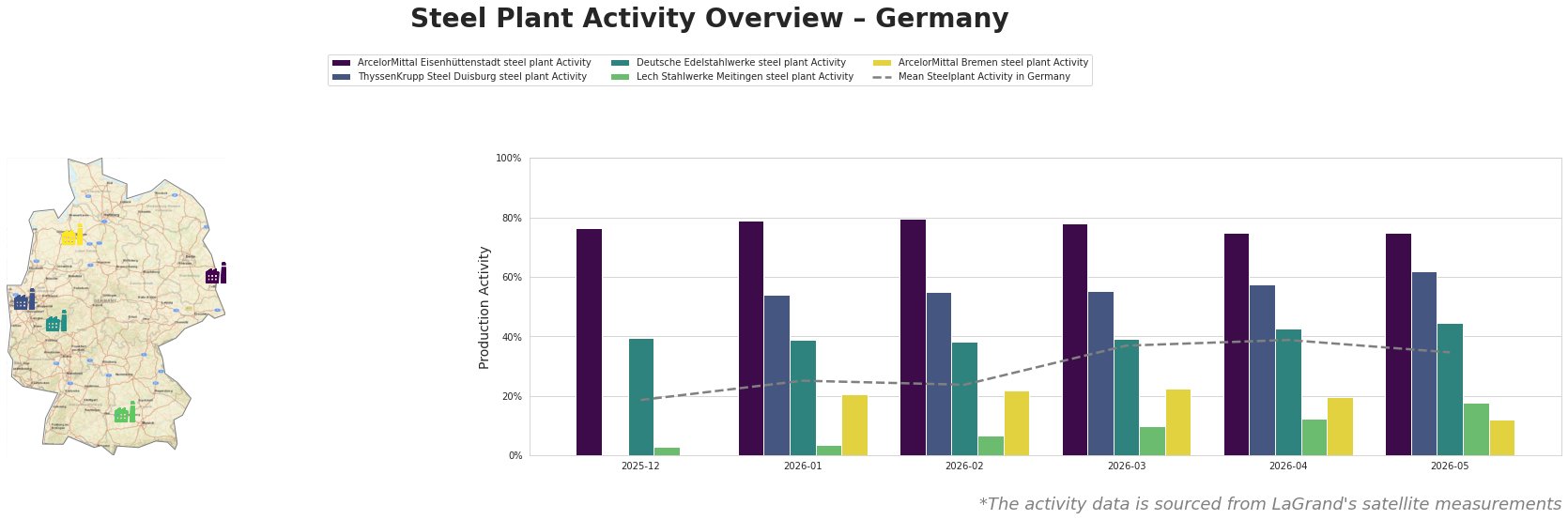
ArcelorMittal Eisenhüttenstadt, with 75% activity, remains significantly above the mean, serving automotive and construction sectors with its integrated production methods. ThyssenKrupp Steel Duisburg also reported a healthy production level of 62%, producing a range of finished and semi-finished products. Interestingly, Deutsche Edelstahlwerke’s activity increased to 45%, reflecting potential steady demand for its specialized steel products, despite political uncertainties. Conversely, Lech Stahlwerke Meitingen and ArcelorMittal Bremen faced marked declines in activity at 18% and 12%, respectively, possibly reflecting lagging demand or operational challenges, though no direct link to the political climate was established.
In summary, while Cem Özdemir und Hendrik Wüst Schwarz-Grün in Deutschland? notes potential changes in political alliances, the direct impact on steel production remains unquantified. Steel buyers should prepare for inconsistencies, particularly from the struggling plants like Bremen and Meitingen and should consider securing contracts with more stable suppliers like the Eisenhüttenstadt and Duisburg facilities.
Potential supply disruptions may occur if political changes restrict resource allocations or investment in infrastructure. Steel procurement professionals are advised to closely monitor political developments and align procurement strategies with the observed production capabilities of various plants, focusing on established suppliers with stable activity levels during this transitional phase.