


From the Field to the Dashboard – Built by Experts, for Experts.
Discover What's Really Happening in the Steel Industry
Use the AI-powered search engine to analyze production activity, market trends, and news faster than ever before.
Try the Free AI Search EngineEurope Steel Market Report: Activity Trends and Trade Policies Influence Neutral Sentiment
In Europe, the steel market sentiment remains Neutral amid significant shifts in production and trade discussions. Recent activity levels at key plants exhibit fluctuations that coincide with calls for stronger trade defenses highlighted in the article “Five EU countries are calling for the bloc to strengthen its trade defenses”. Satellite-observed data indicates these trade measures are likely impacting operational efficiencies at certain plants.
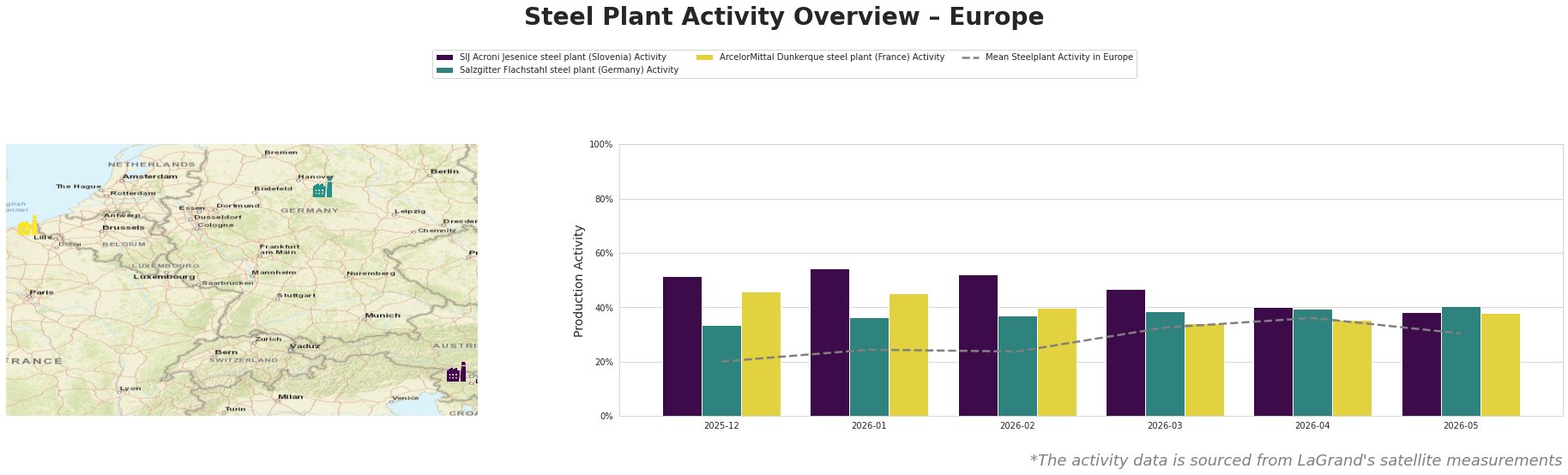
The SIJ Acroni Jesenice steel plant in Slovenia has shown a decline to 38.0% activity in May from 54.0% in January, amid discussions around increased import tariffs and supply chain pressures. The operational adjustments at this plant may directly respond to EU measures as per the “Five EU countries are calling for the bloc to strengthen its trade defenses.” The plant’s focus on flat rolled steel products for infrastructure may be affected by fluctuating demand linked to these economic shocks.
Salzgitter Flachstahl in Germany remained relatively stable, reporting an increase to 41.0% in May, a slight improvement from April’s 40.0%. This stability may relate to ongoing strategic shifts towards renewable energy initiatives and the production of low CO2 steel, although the effects of European trade policy reforms remain to be fully understood.
ArcelorMittal Dunkerque experienced a decrease in activity, falling to 38.0% in May, down from 46.0% in December. The decline coincides with rising geopolitical tensions and economic uncertainties as discussed in the article “Ukraine has launched an anti-dumping investigation into coated steel from four countries.” This may indicate weakening regional demand for their products.
The operational disruptions among these key players necessitate actionable strategies for procurement. Steel buyers should consider:
- Prioritizing sourcing from Salzgitter Flachstahl, given its resilient output amid trade policy shifts, allowing buyers to secure more stable supply.
- Monitoring developments in EU trade regulations especially those articulated in “Five EU countries are calling for the bloc to strengthen its trade defenses,” which may impose further restrictions influencing pricing and availability in the short term.
- Evaluating potential mid to long-term partnerships with producers in the EU who can adapt swiftly to these changing market conditions to avoid supply chain disruptions.
While the European steel market currently holds a Neutral sentiment, emerging dynamics, especially trade-related changes, warrant continuous observation to inform procurement strategies effectively.