


From the Field to the Dashboard – Built by Experts, for Experts.
Discover What's Really Happening in the Steel Industry
Use the AI-powered search engine to analyze production activity, market trends, and news faster than ever before.
Try the Free AI Search EnginePositive Outlook for Steel Market in Asia Amid Stable Activity in Key Plants
Recent developments in the steel market across Asia have been influenced primarily by external factors. Notably, the article “US inflation accelerates to 3-year high in May” indicates that rising energy prices, exacerbated by geopolitical tensions, have led to broader economic challenges affecting steel demand. Despite these challenges, satellite-observed data reveal that activity levels in select steel plants show a predominantly stable trend.
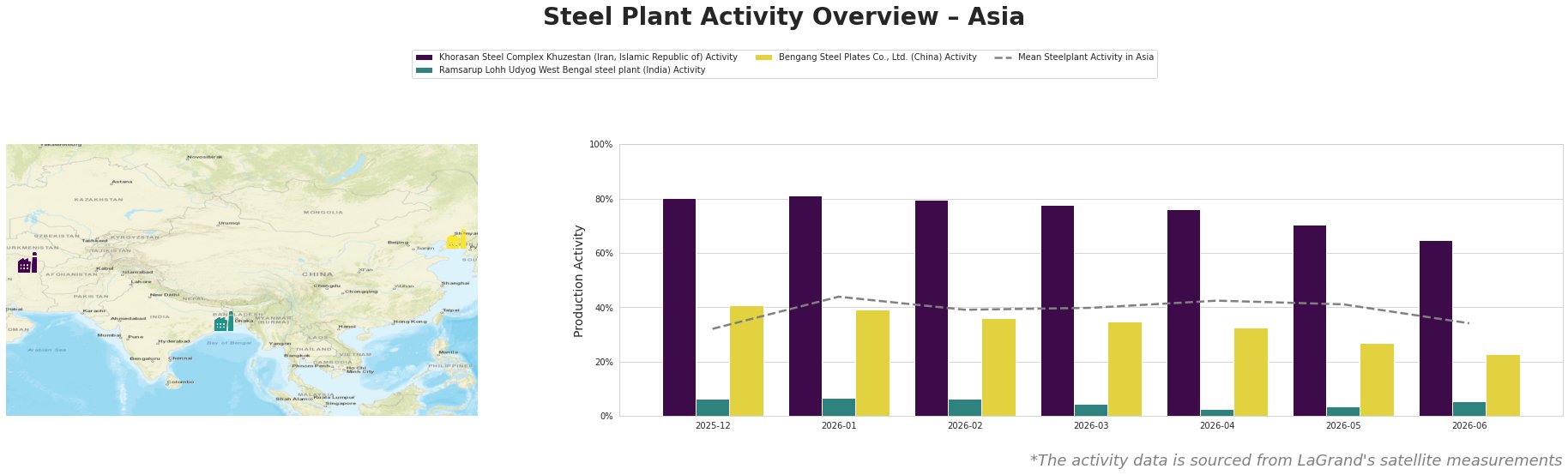
Khorasan Steel Complex in Iran exhibited a strong consistent activity level, peaking at 81% in January 2026, before experiencing a decline to 65% by June 2026. This substantial drop may be linked to rising energy costs detailed in the “US wholesale inflation surges to 6.5pc in May”, although no direct connection to a decline in orders is explicitly established.
Ramsarup Lohh Udyog in West Bengal, India, has seen its activity remain below 10%, highlighting potential operational challenges. The decline from 7% in January to 5% in June could reflect broader supply chain issues arising from inflationary pressures discussed in the “World Bank has downgraded its global growth forecast due to the war in the Middle East”.
Bengang Steel Plates Co., Ltd., despite being a large-scale producer, faced a further decline in activity from 39% in January to 23% by June. The market is likely reacting to increased costs for energy and materials as highlighted in the aforementioned news articles; however, specific correlations to the plant’s operations were not established.
Given the current context, procurement leaders in the steel industry should be aware of potential supply disruptions, particularly from Ramsarup Lohh Udyog, where declining activity signals concerns about output reliability.
Steel buyers are strongly advised to consider strategic pre-purchasing and explore alternative sources to mitigate possible supply chain interruptions, particularly in light of the geopolitical stability highlighted in the US inflation and World Bank forecasts. These insights underscore a potential for rewarding deals amidst fluctuating activity levels but necessitate careful management of procurement strategies.