


From the Field to the Dashboard – Built by Experts, for Experts.
Discover What's Really Happening in the Steel Industry
Use the AI-powered search engine to analyze production activity, market trends, and news faster than ever before.
Try the Free AI Search EngineChina Steel Market Report: Declining Output and Weak Demand Signal Supply Challenges Ahead
China’s steel market is currently facing negative sentiment due to a notable decline in production and rising inventory levels. Recent reports, including “China reduced steel output by 3.9% y/y in January–May“ and “China’s crude steel output down 3.9 percent in January-May 2026, slight rebound in May,” indicate that steel production fell to 415.5 million tonnes, primarily due to a struggling property market and reduced domestic demand. These production cuts align with satellite-observed activity data indicating increased stock levels, notably a 6.6% rise in finished steel inventories by June 10, associated with weak demand, as emphasized in “CISA mills’ daily crude steel output up 3.8% in early June 2026, stocks also up.”
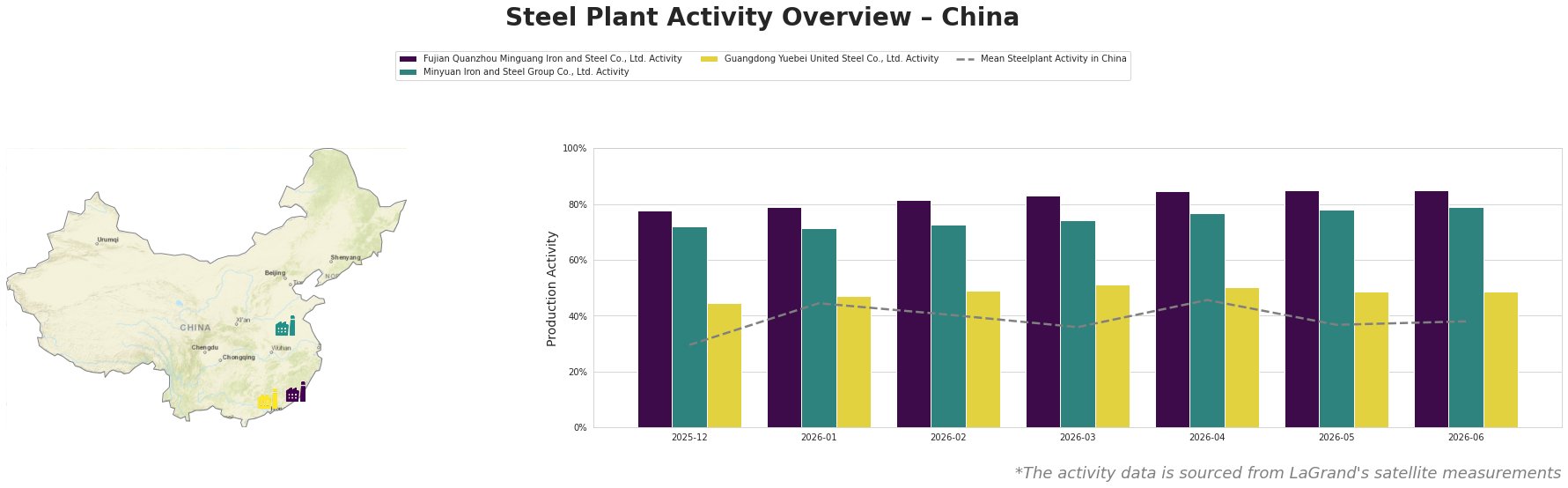
Fujian Quanzhou Minguang Iron and Steel Co., Ltd. has maintained activity levels at 85% throughout May and early June, indicative of robust output despite overall declines across the industry. However, the plant’s product mix, primarily focused on finished rolled products, may be at risk if weak demand persists. Minyuan Iron and Steel Group Co., Ltd. also witnessed activity levels consistently in the high 70s but is now experiencing pressure due to rising inventories linked to low demand as referenced in “CISA mills’ daily crude steel output up 3.8% in early June 2026, stocks also up.” Guangdong Yuebei United Steel Co., Ltd.’s lower activity at 49% reflects challenges in operations, potentially due to the high temperatures and seasonal impacts hindering construction.
Potential supply disruptions are emerging as a key concern, particularly for buyers relying on large producers like Fujian and Minyuan, where rising stock levels could hinder the ability to fulfill orders promptly. Steel buyers should consider this context when making procurement decisions. It is advisable to engage early with suppliers to secure volume and mitigate potential shortages as production adjustments continue in response to stagnant demand.
In light of these developments, steel buyers should actively monitor inventories tied to production output, particularly focusing on Fujian and Minyuan’s sustained activity levels, which could present opportunities to negotiate favorable terms while also anticipating further market adjustments as demand remains weak.