


From the Field to the Dashboard – Built by Experts, for Experts.
Discover What's Really Happening in the Steel Industry
Use the AI-powered search engine to analyze production activity, market trends, and news faster than ever before.
Try the Free AI Search EngineIran Steel Market Report: Activity Decline Amidst Diplomatic Uncertainty
Recent developments in Iran’s steel market indicate an overall negative sentiment, highlighted by a notable drop in activity levels across major production sites. The Hormuz tanker traffic unchanged after US‑Iran deal signals a continued hesitance among vessel operators to navigate the Strait of Hormuz, raising concerns about regional trade stability. This reluctance aligns with observable trends in steel plant operations as depicted in satellite data.
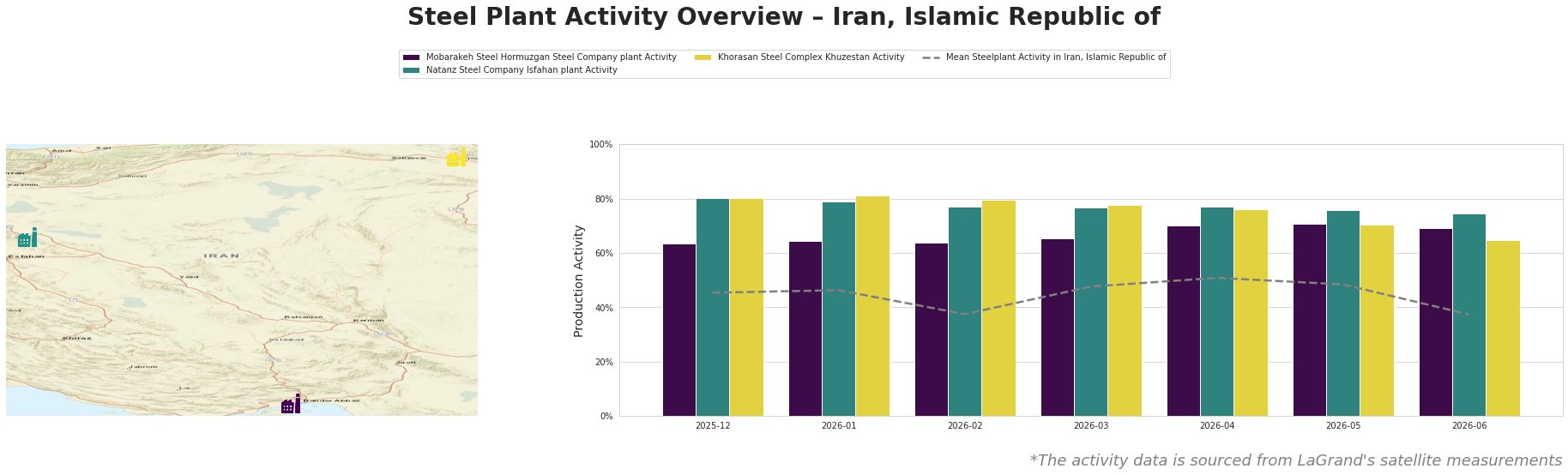
Mobarakeh Steel’s activity has sharply declined from 71% in May to 69% in June, suggesting a gradual downturn in output amidst growing uncertainties reflected in the Trump Iran framework gambles on diplomacy despite warning Tehran will ‘lie and cheat’ article, which discusses Iran’s weakened industrial capabilities amidst diplomatic negotiations.
Natanz Steel observed a slight decline from 76% to 75%, maintaining activity but reflecting the broader market’s fears of instability as noted in the prevailing news narratives. Meanwhile, Khorasan Steel complex’s activity has also decreased, from 70% to 65%, aligning with concern over trade routes as indicated by the aforementioned Hormuz tanker traffic unchanged article.
Evaluated Market Implications:
The observed reduced activity levels across plants suggest potential supply disruptions, particularly for Mobarakeh Steel and Khorasan Steel. Steel buyers should prepare for anticipated shortages as rigorous checks and delays impact logistical operations linked to the Strait of Hormuz. Recommended actions include:
- Increase inventory levels for critical products, particularly from Khorasan and Mobarakeh, as their respective output levels are at risk due to geopolitical tensions.
- Explore alternative procurement sources within Iran and neighboring regions to mitigate reliance on major production facilities showing declining activity trends since March.
- Monitor updates on US-Iran diplomatic negotiations, especially the upcoming deal signing on June 19, which may further influence trade conditions and operational capacity in the region.
By evaluating these shifts in activity alongside the current geopolitical landscape, stakeholders can better navigate the complexities of the Iranian steel market.