


From the Field to the Dashboard – Built by Experts, for Experts.
Discover What's Really Happening in the Steel Industry
Use the AI-powered search engine to analyze production activity, market trends, and news faster than ever before.
Try the Free AI Search EngineStrong Demand Fuels Steel Production Surge in Europe Amid Supply Concerns
Steel activity levels in Europe show a very positive sentiment, driven by strong demand and recent developments outlined in Fitch raises iron ore and coking coal price forecasts amid supply disruptions and higher costs. The ongoing price adjustments have resulted from heightened shipping costs and robust demand from steelmakers. Notably, the increased exports from Australian coking coal and iron ore in May 2026 (Australian coking coal exports climb up in May 2026 on strong Asian offtake and Iron ore exports via Port Hedland up 10.3 percent in May 2026 from April) reinforce this market dynamic, correlating with satellite-observed production trends at key European plants.
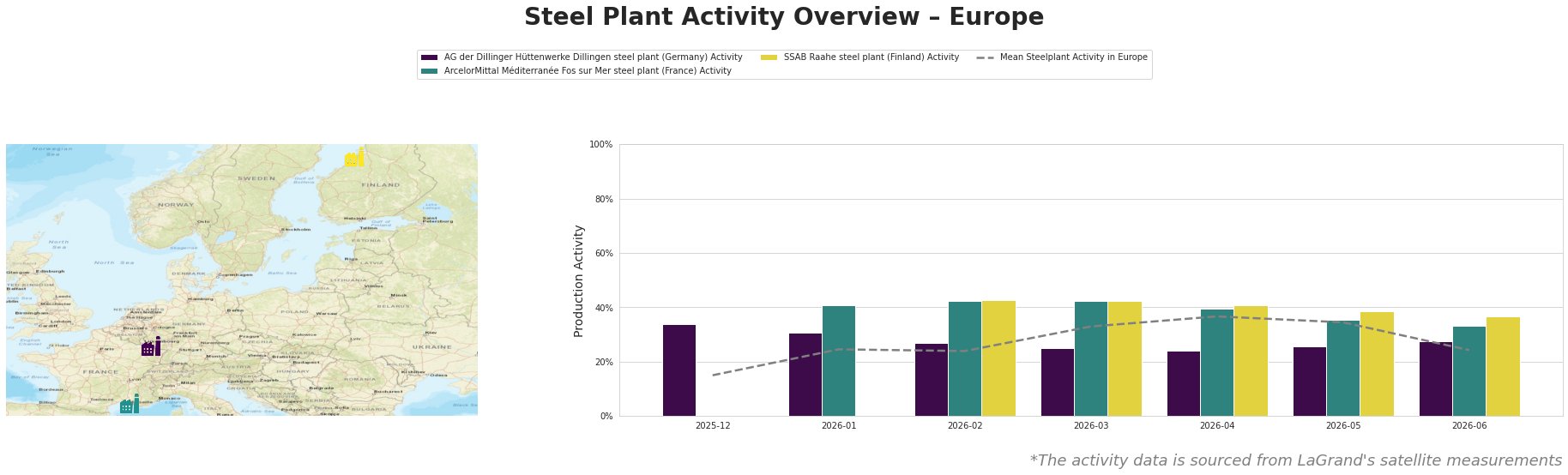
The AG der Dillinger Hüttenwerke Dillingen steel plant, while exhibiting fluctuating activity levels, peaked at 34% in December 2025, subsequently decreasing to 24% by April 2026, with a slight recovery to 28% in June 2026. This decline may be linked to the increasing iron ore and coking coal prices affecting production costs, as detailed in Fitch raises iron ore and coking coal price forecasts amid supply disruptions and higher costs.
ArcelorMittal Méditerranée Fos sur Mer steel plant displayed significant activity, particularly peaking at 42% in February. However, the observed reduction to 33% by June 2026 indicates potential constraints on production capacity amid rising input costs, reflecting trends reported about coking coal price hikes (Fitch raises iron ore and coking coal price forecasts).
The SSAB Raahe steel plant showed steady activity levels, maxing out at 43% in February and slightly tapering to 37% by June 2026. The resilience of this plant is noteworthy given the rising demand for steel products, including those from coking coal as indicated by the ongoing supply disruptions.
In light of these dynamics, steel buyers should consider the following actionable procurement strategies:
-
Anticipate Supply Disruptions: As coking coal prices continue to rise and supply remains uncertain due to geopolitical tensions, buyers should secure long-term contracts now, particularly considering the disruptions cited in the news articles.
-
Strategic Sourcing: Given Australia’s increasing coal exports to Asia, buyers might leverage this by exploring alternative sourcing strategies that capitalize on this uptick while navigating fluctuating European market demands due to local price increases.
-
Monitoring Market Trends: Keep a close watch on the activity levels of European steel plants relative to external supply conditions. This involves tracking shifts linked to the iron ore and coking coal markets, which are central to maintaining production levels and managing costs effectively.
By aligning procurement strategies with the latest data and news insights, steel buyers can better navigate the evolving landscape marked by strong demand and emerging supply-side challenges.