


From the Field to the Dashboard – Built by Experts, for Experts.
Discover What's Really Happening in the Steel Industry
Use the AI-powered search engine to analyze production activity, market trends, and news faster than ever before.
Try the Free AI Search EngineSteel Market in Asia Faces Significant Contraction Amid Heightened Resource Pressures
Recent developments in Asia’s steel market signal a Very Negative sentiment, primarily driven by declining plant activity levels and rising crude oil prices. Notably, the article Japan to release second batch of oil reserves from May indicates a constrained energy supply situation affecting operational costs for steel production. This is further corroborated by global trends, including the US oil inventories fall on record exports: Update, suggesting a tightening crude supply, which directly impacts steel manufacturing costs. Current trends at key steel plants indicate a significant slowdown in activity.
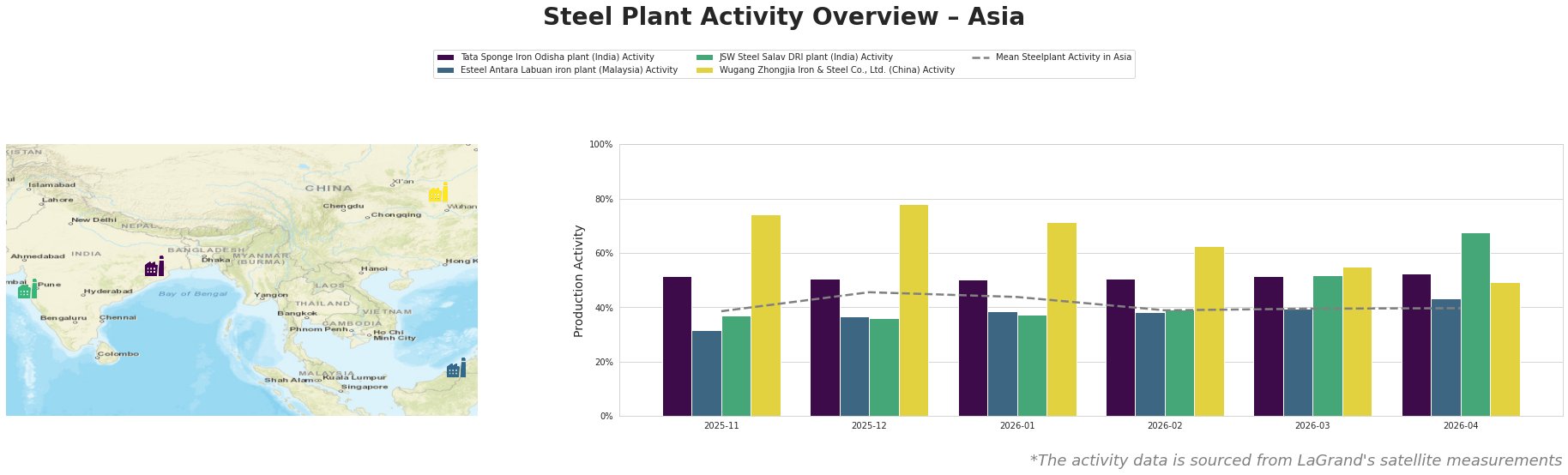
As of April 2026, the Mean Steelplant Activity in Asia is noted at just 40.0%, reflecting a downward trend from previous months. The Tata Sponge Iron Odisha plant has maintained a relatively stable operation, peaking at 52.0% in April, suggesting resilience amidst broader market challenges. In contrast, the Esteel Antara Labuan iron plant has seen a significant drop to 43.0%, continuing a decline that aligns with the increasing costs described in the article Crude futures surge 7pc to new four-year high; these elevated energy costs are limiting operational efficiency across the board. Lastly, while the JSW Steel Salav DRI plant has experienced some recovery to 68.0% in activity, the overall trend suggests a sector-wide downturn.
The Wugang Zhongjia Iron & Steel Co., Ltd. exhibits volatility with a drop to 49.0% in April, falling behind the mean activity level, which hints at potential supply disruptions linked to rising operational costs and uncertain crude supplies.
To navigate the current landscape, steel buyers should procure materials judiciously, focusing on suppliers with robust energy efficiency measures and securing contracts that factor in potential supply chain disruptions. Strengthened energy procurement strategies are essential in this environment. Monitoring the impact of Japan’s crude reserve release during upcoming months will be crucial as it may alleviate some pressures but also indicates an ongoing struggle for stable energy resources in the region.