


From the Field to the Dashboard – Built by Experts, for Experts.
Discover What's Really Happening in the Steel Industry
Use the AI-powered search engine to analyze production activity, market trends, and news faster than ever before.
Try the Free AI Search EnginePositive Outlook for the European Steel Market Amid New Trade Regulations
Recent developments in Europe’s steel market signal a favorable outlook for stakeholders. The article, “European Council details trade regime amendments,” outlines new steel trade regulations featuring a substantial annual quota of 18,345,922 tonnes, with a punitive 50% duty on excess imports. These regulations, which are expected to impact import flows significantly, coincide with increased activity among certain steel manufacturing plants, as evidenced by monthly satellite data.
The overall steel plant activity across Europe has shown notable fluctuations. The mean activity level measured across facilities as of April 30, 2026, was 35%. Key players exhibit diverse performance trends: Mannesmann Line Pipe GmbH, Werk Siegen, recorded stable activity at 30%, while the Hamm facility maintained at 31%. In contrast, Aperam Stainless Belgium’s Châtelet plant experienced a drop to 29%, reflecting operational adjustments possibly linked to the anticipated regulatory changes impacting import volumes.
Monthly Activity Overview
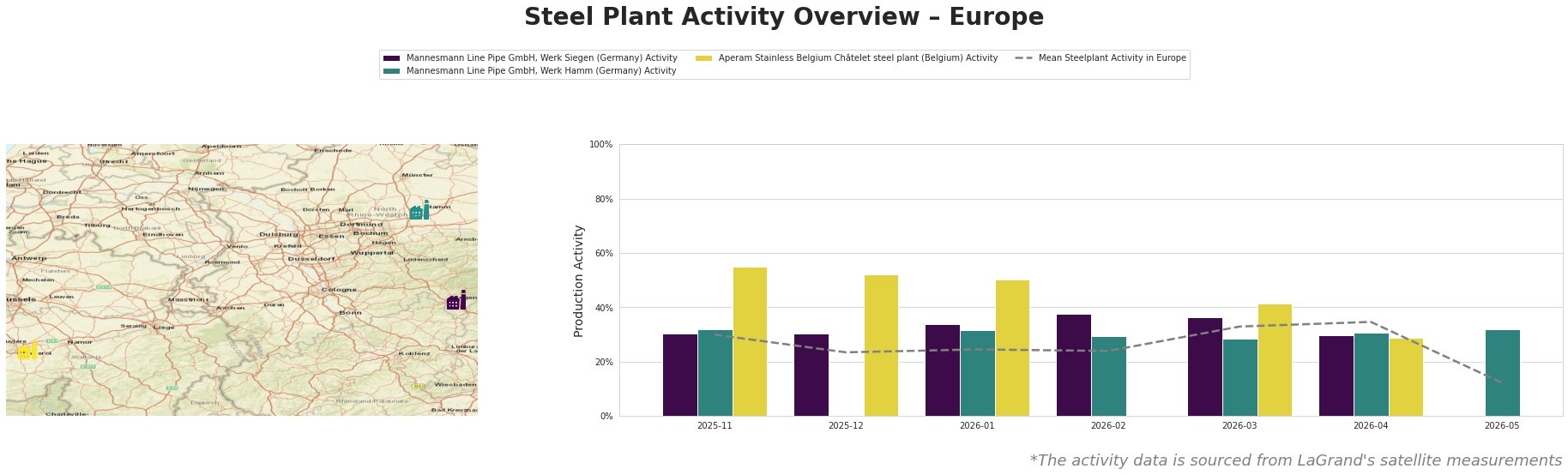
The Mannesmann Line Pipe GmbH, Werk Siegen plant, with an electric arc furnace (EAF), has consistently operated around 30%, but showing resilience amid the regulatory review process. The article “The European Council describes in detail the amendments to the trade regime“ does not establish a direct correlation to its activity shifts but indicates the sector’s overall stability.
Mannesmann Line Pipe GmbH, Werk Hamm, also with EAF processes, showed slightly elevated activity at 31%. Similar to the Siegen facility, its stability is observed despite an overall declining mean activity, aligning with the “Final EU steel trade framework draft keeps carry-over,” which emphasizes the protection of existing quotas potentially benefiting domestic production.
Conversely, Aperam Stainless Belgium Châtelet, which fabricates stainless steel through EAF technology, dropped slightly to 29%. The dramatic decrease from its previous peak can be partially attributed to changes outlined in “UK trade measures will lead to disruptions in the supply of stainless steel bars,” where tighter UK quotas may have created supply chain constraints affecting European dynamics.
Evaluated Market Implications
The newly introduced trade regulations are likely to disrupt supply chains temporarily due to the quota limits being enforced, particularly affecting stainless steel production from facilities like Aperam. Stakeholders are advised to consider building inventory ahead of the July roll-out date for these new regulations to mitigate risks associated with supply disruptions. Procurement teams must closely monitor the implications of “European Council details trade regime amendments” and plan for potential price shifts and availability constraints. Engaging with local suppliers could also yield advantageous procurement terms under the new meta-rules governing imports, particularly in the context of rising tariffs and reduced quotas.