


From the Field to the Dashboard – Built by Experts, for Experts.
Discover What's Really Happening in the Steel Industry
Use the AI-powered search engine to analyze production activity, market trends, and news faster than ever before.
Try the Free AI Search EngineEuropean Steel Market Update: Neutral Sentiment Amidst Demand Fluctuations and Price Variability
European steel activity reflects a neutral sentiment as the market grapples with differing dynamics. The article Thick-sheet steel prices in Europe are rising due to constant orders suggests sustained demand for thick steel sheets, contributing to upward price pressures. Conversely, the European HRC market is losing momentum amid sluggish demand indicates stagnation in hot-rolled coil prices due to weak demand and rising inventories. These phenomena align with observed satellite activity data from prominent plants, revealing shifts primarily driven by market conditions.
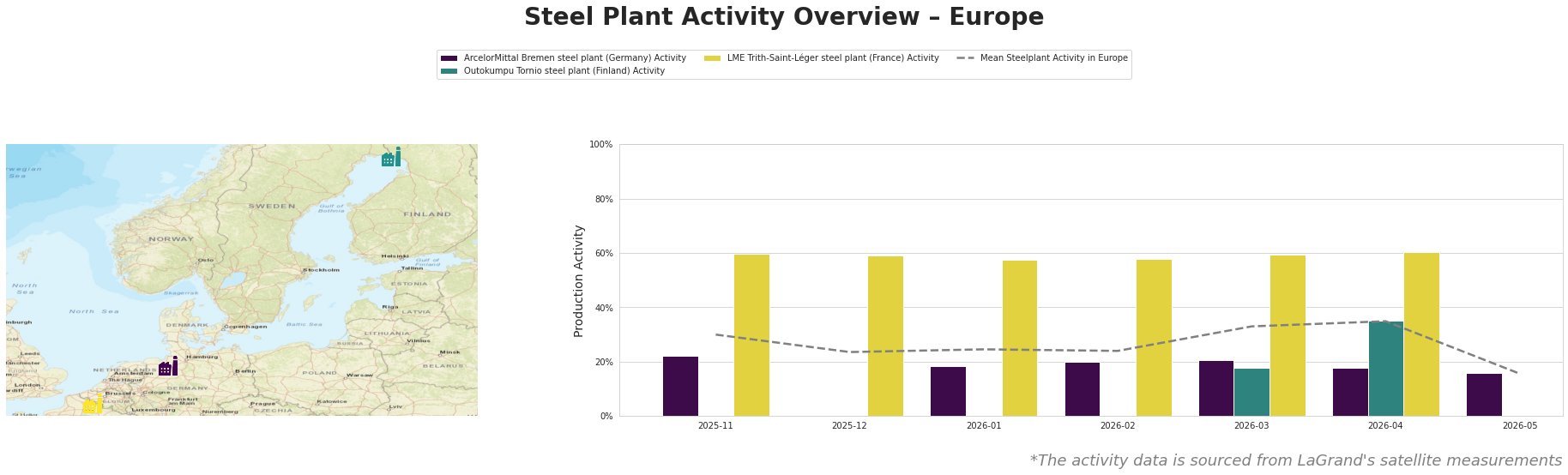
The ArcelorMittal Bremen plant has witnessed reduced activity, dropping to 18% as of April 2026, which may correlate with reported price peaks for hot-rolled coils being deemed unrealistic by market participants in The European HRC market is losing momentum amid sluggish demand. Similarly, the significant decline to 16% by May suggests broader market pressures, though no direct links can be firmly established with the observed demand dynamics.
In contrast, the Outokumpu Tornio plant indicates a more robust activity at 35% in April 2026, aligning with strengthening demands for thick steel products as evidenced by Thick-sheet steel prices in Europe are rising due to constant orders. This suggests that while the HRC sector battles sluggish demand, there exists a stabilizing influence from segments focusing on thick sheet production.
The LME Trith-Saint-Léger plant shows stable activity at 60%, which, while indicative of current strong operational capacity, has not directly tied into the overarching price dynamics discussed in the news articles.
Amid these diverse signals, steel buyers should anticipate potential disruptions in supply stemming from fluctuating activity levels, especially at plants like ArcelorMittal Bremen and Outokumpu in response to broader demand trends. Given the insights from aforementioned articles and plants, buyers are advised to:
– Secure HRC inventories cautiously, aligning purchases with observed steel price stability.
– Explore thick sheet procurement options aggressively, leveraging current momentum and stable demand seen in that segment.
– Monitor potential short-term production halts or downtimes, especially in regions showing significant drops in operational activity.
Providing timely adjustments in procurement strategies aligned with observed dynamics and recent news will help in navigating this phase of the European steel market effectively.