


From the Field to the Dashboard – Built by Experts, for Experts.
Discover What's Really Happening in the Steel Industry
Use the AI-powered search engine to analyze production activity, market trends, and news faster than ever before.
Try the Free AI Search EnginePositive Trends in Asia’s Steel Market Amid Decarbonization Challenges
In Asia, particularly in China and India, the steel industry’s potential for decarbonization is gaining attention as outlined in the article “Report: China, India Control the Fate of Steel Decarbonization.” Recent satellite observations confirm an increase in operational levels across significant plants, despite concerns highlighted in “The steel industry is concerned about the slow progress of green steel projects.” Notable shifts in activity levels provide critical insights for buyers and analysts.
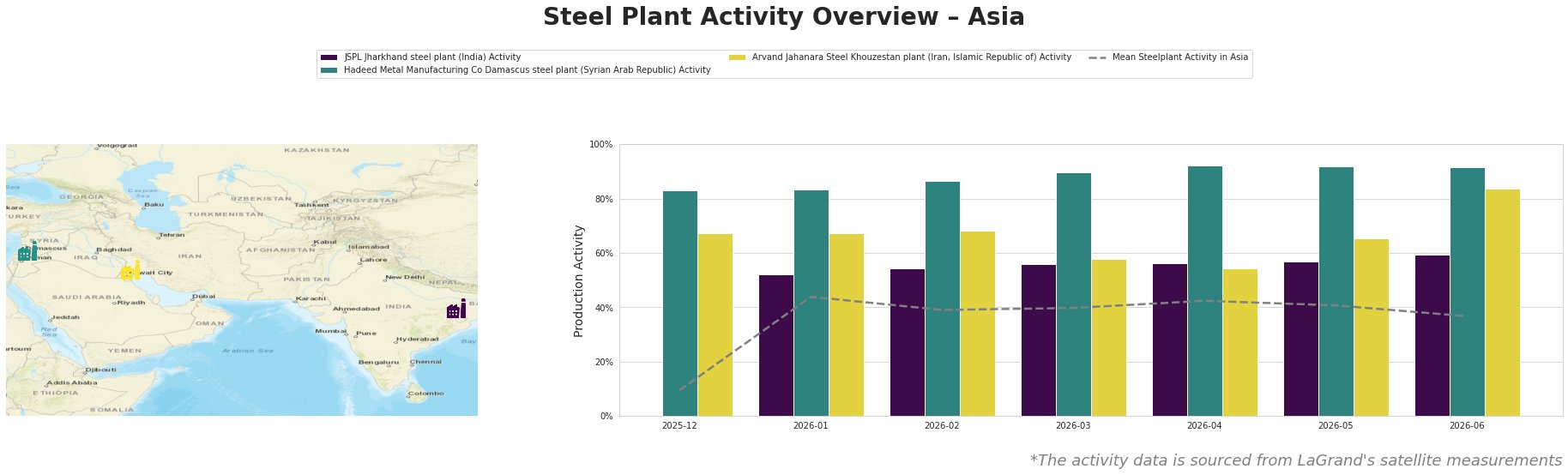
The JSPL Jharkhand steel plant exhibits a steady activity level with an increase from 52.0% in January to a peak of 60.0% by June 2026, aligning with “Report: China, India Control the Fate of Steel Decarbonization”, which emphasizes the critical role of EAF technology. Although it currently lacks certifications for sustainability, the plant’s commitment to Electric Arc Furnace (EAF) technology positions it to adapt towards greener practices, aligning with projected market trends.
Hadeed Metal Manufacturing Co has consistently high activity levels around 90% from March to June 2026, which may be bolstered by emerging regional demand despite challenges highlighted in “The steel industry is concerned about the slow progress of green steel projects.” The plant utilizes two EAFs for production and is strategically poised in the infrastructure sector, which remains resilient amid fluctuating green steel demands.
The Arvand Jahanara Steel Khouzestan plant saw a significant rise from 67.0% to 84.0% between December 2025 and June 2026, reflective of a broader uptick in production capabilities amid concerns about delayed green initiatives. However, recent observations do not establish a concrete link to any specific news developments.
Evaluated Market Implications
Given the observed upward trends in operational activity, particularly at Hadeed and Arvand, procurement strategies for steel buyers should pivot to securing contracts with these plants as they appear capable of fulfilling potential demand surges, especially for structural and semi-finished products. However, the variability in JSPL’s activity suggests a need for monitoring and possibly diversifying supplies to mitigate risks associated with delayed transitions to sustainable practices. As such, it is prudent for buyers to secure agreements with plants demonstrating high activity levels while remaining cognizant of the evolving landscape concerning environmental regulations and decarbonization strategies in Asia.