


From the Field to the Dashboard – Built by Experts, for Experts.
Discover What's Really Happening in the Steel Industry
Use the AI-powered search engine to analyze production activity, market trends, and news faster than ever before.
Try the Free AI Search EngineNegative Sentiment Grows in Europe’s Steel Market Amid New Import Quotas
Europe’s steel industry is facing mounting pressure as significant changes to import quotas and tariffs loom, with professionals bracing for supply disruptions. Key articles such as British Chambers of Commerce warns UK steel quota changes to disrupt SME costs, logistics and Tariff quota negotiations are politicizing European steel imports shed light on how these impending adjustments, taking effect July 1, 2026, have already resulted in halting procurement activities and concern over local production constraints.
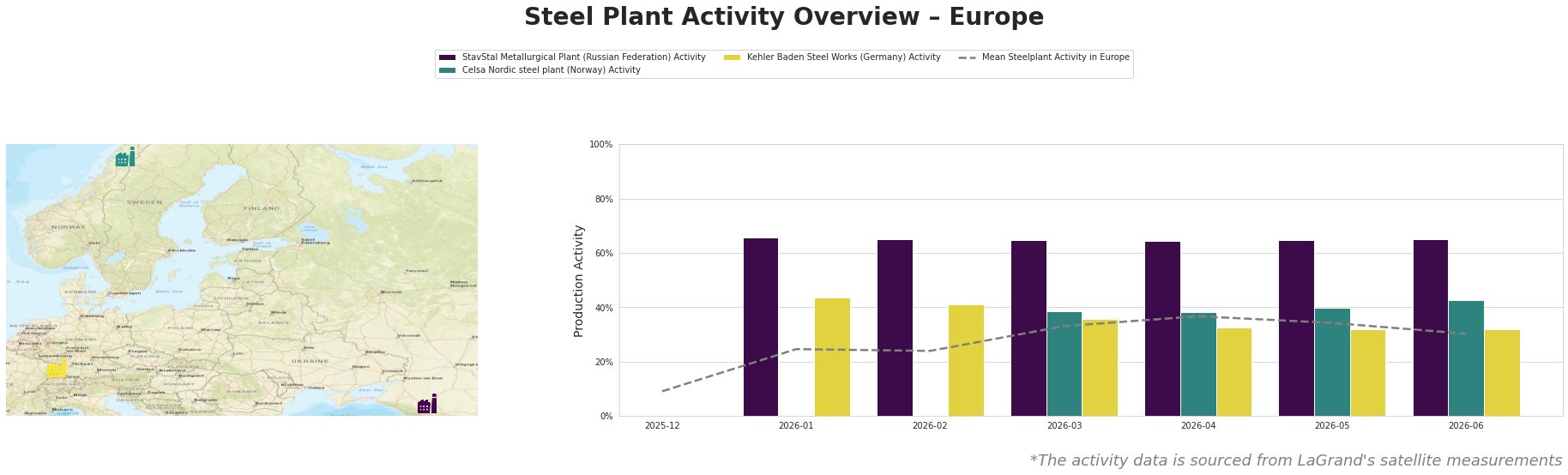
Recent satellite data shows fluctuations in activity levels among notable European steel plants, indicating a downturn in operational capacity. The mean steel plant activity in Europe dropped from 34% in May to 30% by June 2026, demonstrating a sluggish response to the market’s pressing dynamics.
StavStal Metallurgical Plant
Located in Stavropol Krai, the StavStal Metallurgical Plant saw a stable activity level at 65% from January through June 2026. Despite general market pressures indicated by the BCC warns UK steel import restrictions could create ‘cliff-edge’ for manufacturers, StavStal’s consistent output could insulate it from immediate disruptions impacting other regional producers. No direct correlation between plant performance and recent news developments can be established.
Celsa Nordic Steel Plant
The Celsa Nordic Steel Plant, operational in Norway, exhibited a notable rise in activity to 43% in June 2026, unlike its counterparts. The increase contrasts with warnings from articles like Tariff quota negotiations are politicizing European steel imports, which indicate that a failure to finalize quota agreements could affect procurement decisions. Celsa’s resilience may serve as a beacon for the European market amidst uncertainty.
Kehler Baden Steel Works
Kehler Baden Steel Works in Germany faced a drop to an activity level of 32% in June after stabilizing around 36% in the prior months. This decline underscores the negative outlook for operations as highlighted in In Britain, warnings are being issued about the threat to business posed by new steel import quotas. The significant reliance on imported raw materials and challenges in procurement thin out Kehler’s operational capabilities, exacerbated by looming tariff increases.
Potential supply disruptions are imminent across the UK and EU markets due to rigid import quota changes, particularly for SMEs heavily reliant on affordable steel imports, as asserted in multiple articles. Steel buyers should prepare for possible allocation challenges and negotiate early contracts with suppliers to mitigate costs. Proactive inventory management is recommended especially for entities relying on the Kehler Baden Steel Works for construction and manufacturing needs, while observers should continuously assess shifts in Celsa’s activity as a possible model for resilience amid market turbulence.