


From the Field to the Dashboard – Built by Experts, for Experts.
Discover What's Really Happening in the Steel Industry
Use the AI-powered search engine to analyze production activity, market trends, and news faster than ever before.
Try the Free AI Search EngineOceania Steel Market Update: Ongoing Declines and Caution in Procurement Strategies
The Oceania steel market is facing a negative sentiment characterized by diminishing activity across major steel production facilities. Recent articles such as “The European HRC steel market freezes in anticipation of the details of the decision on protective measures“ and “European steel HRC market mostly quiet ahead of new safeguard measures“ reflect a cautionary mood similar to that observed in satellite readings of local steel plant activities, highlighting a worrying trend of reduced operational throughput.
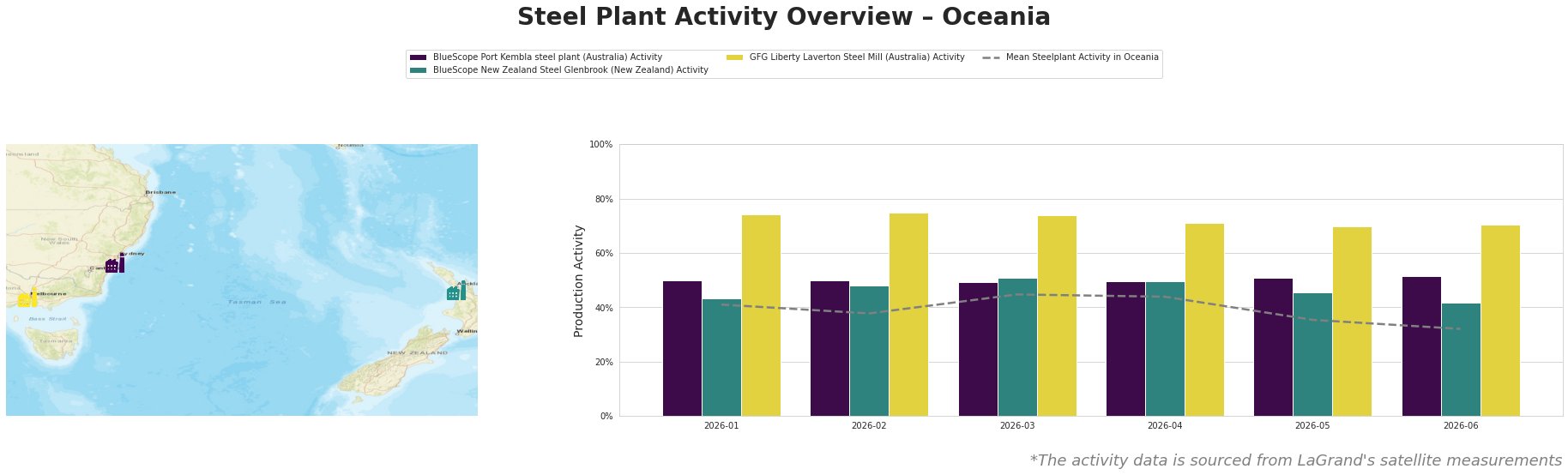
In June, a marked decline in overall mean activity to 32.0% was noted, particularly evident with GFG Liberty Laverton showing a drop from 75.0% to 70.0%, and BlueScope New Zealand Steel Glenbrook falling from 51.0% to 42.0%. This downward trend aligns with the cautious buying sentiment highlighted in the news articles regarding imports and the stagnation stemming from anticipated regulatory changes. Notably, BlueScope Port Kembla maintained slight improvements, likely due to stable local demand, indicating the facility operated at 52.0% capacity.
The BlueScope Port Kembla steel plant in New South Wales, featuring integrated steel production, showed resilience in June with activity increasing to 52.0%. This is a strong indicator of local demand for semi-finished and finished products. Despite this, the atmosphere remains rife with uncertainty as European sentiment, particularly articulated in articles discussing “weak demand”, likely has ramifications for port activities as international markets adjust to upcoming trade measures.
In contrast, BlueScope New Zealand Steel Glenbrook exhibited a significant reduction in production activity, from 51.0% in May to 42.0% in June. The facility, relying on DRI technology, serves a diverse range of sectors, underscoring the negative hit from softening demand noted in those key articles.
Conversely, GFG Liberty Laverton operates with an electric arc furnace and recorded a slight decline to 70.0% capacity. Although still robust relative to its peers, the mill’s adjusted output may connect to broader market trepidations as suppliers recalibrate in response to regional impacts tied to European market shifts.
The interconnected observations prompt potential supply disruptions, especially out of New Zealand where reduced production could adversely affect local infrastructure projects. Consequently, procurement strategies should pivot to securing earlier contracts or diversifying supply sources to mitigate risks linked to the volatile European market climate.
Steel buyers should prioritize suppliers with consistent output, like BlueScope Port Kembla, while also keeping contingency plans in place as market sentiment evolves with the impending regulatory landscape. Direct ties between local production metrics and European actions highlight the critical need for strategic decision-making in the face of a changing global steel environment.