


From the Field to the Dashboard – Built by Experts, for Experts.
Discover What's Really Happening in the Steel Industry
Use the AI-powered search engine to analyze production activity, market trends, and news faster than ever before.
Try the Free AI Search EngineNorth American Steel Market Outlook: Positive Trends Amid Tariff Adjustments
Recent developments in North America’s steel market indicate a very positive sentiment driven by significant changes in tariff policies and an uptick in plant activities, particularly in Mexico and the U.S. Notably, Mexico is seeking to eliminate steel tariffs as part of the USMCA review and Trump has reduced tariffs on certain steel and aluminum products, which could enhance regional production capabilities and international competitiveness. However, Canada will extend its tariffs on steel and aluminium imports for a further year, potentially leading to regional operational adjustments. The satellite-observed data indicates varied activity levels across key steel plants, reflecting the latest market dynamics.
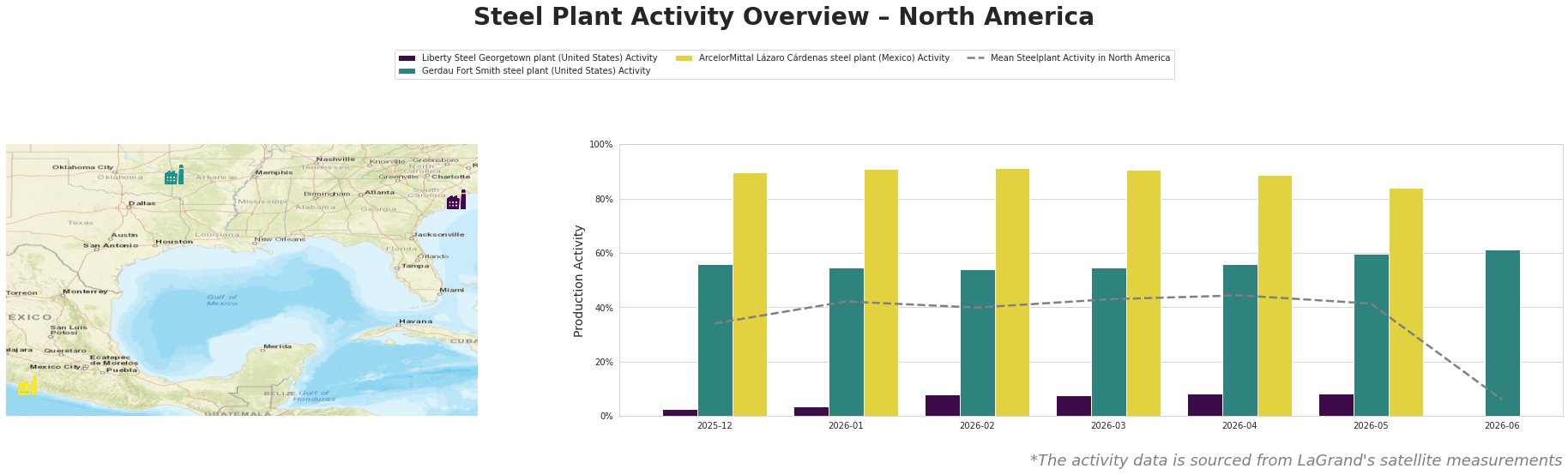
The Liberty Steel Georgetown plant (South Carolina), historically at lower activity levels—peaking at just 8.0%—has maintained minimal production even amidst tariff adjustments. The local tariff environment remains restrictive, with no direct connections to recent news developments established.
Conversely, the Gerdau Fort Smith steel plant (Arkansas) shows a noticeable increase, reaching 61.0% activity by June 2026. The reduction in tariffs on certain imports (per Trump has reduced tariffs on certain steel and aluminum products) appears to have fostered a more favorable operational climate, supporting increased activity.
In stark contrast, the ArcelorMittal Lázaro Cárdenas plant (Mexico) demonstrated consistently high activity, reaching 91.0% in early 2026 before experiencing a decline to 84.0% by May. The local drive to eliminate tariffs (highlighted in Mexico is seeking to eliminate steel tariffs as part of the USMCA review) is likely aimed at sustaining these high operational levels post-tariff discussions.
Evaluated Market Implications
The Liberty Steel Georgetown plant’s stagnation signals potential supply disruptions in the forthcoming months should activity levels not improve, particularly as regional producers facing tariff burdens maintain competitive pressures. Steel buyers should consider diversifying supply sources away from this plant to mitigate risks.
For buyers and analysts, the Gerdau Fort Smith and ArcelorMittal Lázaro Cárdenas plants present immediate procurement opportunities amid heightened activity levels, largely spurred by favorable tariff adjustments. Investing in these plants could yield timely access to steel products corresponding to growing regional demands.
Procurement strategies should focus on partnerships with these key players to leverage the uptick in production capabilities and navigate the evolving tariff landscape effectively.