


From the Field to the Dashboard – Built by Experts, for Experts.
Discover What's Really Happening in the Steel Industry
Use the AI-powered search engine to analyze production activity, market trends, and news faster than ever before.
Try the Free AI Search EngineIndia Steel Market Report: Positive Growth Driven by JSW Expansion Plans
JSW Steel Ltd.’s recent announcement about investing $2.5 billion in capacity expansion signals a robust outlook for India’s steel industry amid increasing domestic demand. This expansion aligns with substantial government investments in infrastructure, as detailed in the articles titled “The largest steel producer will invest $2.5 billion in capacity expansion“ and “JSW Steel is accelerating its capacity expansion in India.” Satellite data reflects enhanced activity returns, particularly at JSW Steel’s facilities, confirming these projections.
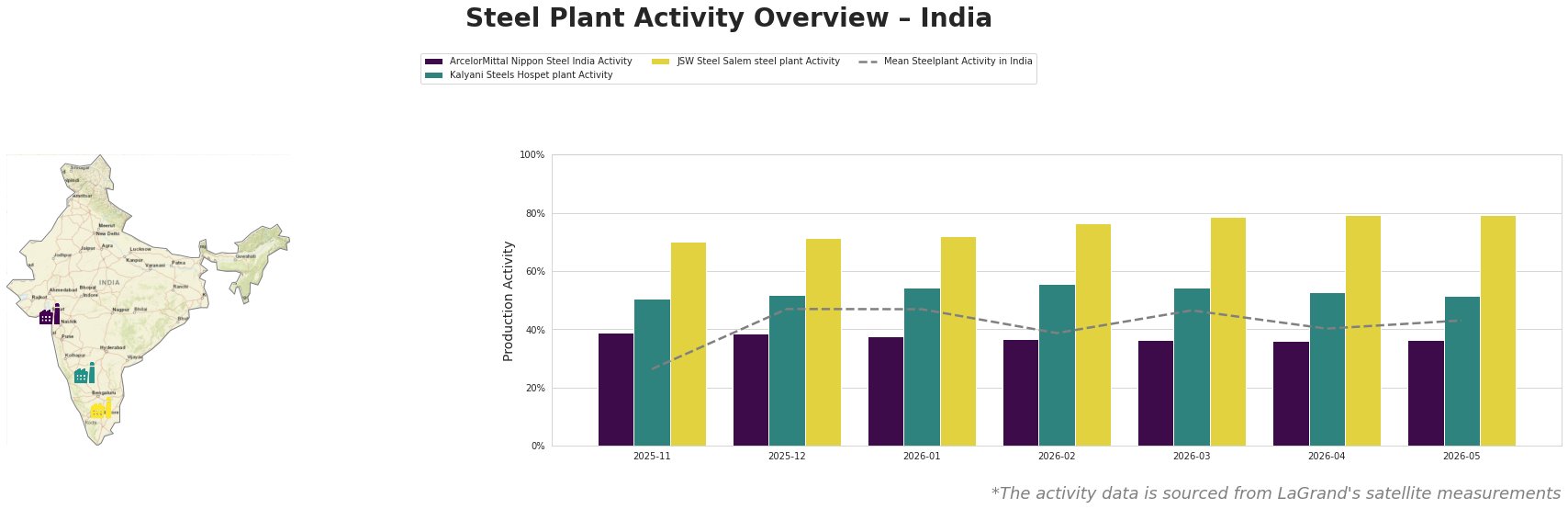
The operational activity at JSW Steel Salem steel plant has shown an impressive rise from 70% in November 2025 to 79% in March 2026, which corresponds with the positive sentiment of expected increased demand shared by CEO Jayanta Acharya in the article “JSW Steel is investing $2.5 billion in capacity expansion.” Meanwhile, ArcelorMittal Nippon Steel India has seen a slight downturn, dropping to 36% by April and May 2026, with no direct connection to JSW’s expansion identified. Kalyani Steels’ Hospet plant has maintained higher activity levels, peaking at 56% in February 2026, but its connection to broader market trends remains unclear.
Market Implications
JSW’s expansive plans, supported by increased activity data at their Salem plant, indicate a likely rise in supply availability in the near future. Steel buyers should consider procuring in advance, particularly from JSW, to lock in pricing before anticipated domestic demand elevates prices. However, the decrease in activity at ArcelorMittal Nippon could suggest potential supply gaps. Buyers may want to diversify their sourcing strategies to mitigate risks associated with geopolitical factors that could further stress supply chains as mentioned regarding regional instabilities in the Middle East.
In conclusion, strategically increasing procurement from JSW in anticipation of future capacity boosts while balancing the risk of supply disruptions from ArcelorMittal could position buyers advantageously as market conditions evolve.