


From the Field to the Dashboard – Built by Experts, for Experts.
Discover What's Really Happening in the Steel Industry
Use the AI-powered search engine to analyze production activity, market trends, and news faster than ever before.
Try the Free AI Search EngineEurope’s Steel Market Update: Price Adjustments Amid Supply Concerns
European steel processors are raising alarms over sustainability regarding rising coil costs, as seen in the article “EU steel processors question sustainability of price hikes.” Concurrently, the “EU HRC: Market sees dip as temporary“ indicates trends in hot-rolled coil (HRC) price fluctuations, with significant implications on manufacturing and procurement strategies. These articles are closely tied to satellite-observed activities revealing notable shifts in several steel plants across Europe.
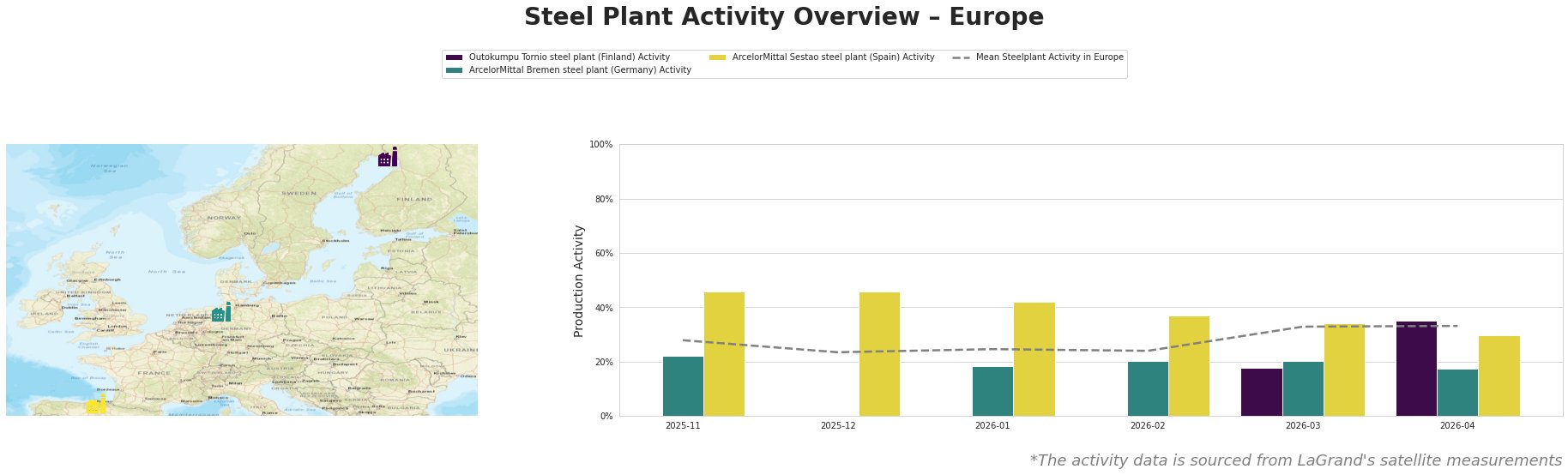
Outokumpu Tornio’s activity surged from 0% in March to 35% in April, signaling a rebound likely influenced by domestic demand related to rising prices noted in “EU HRC: Market sees dip as temporary.” In stark contrast, ArcelorMittal Bremen’s significant drop to 18% in April correlates with challenges articulated in “EU steel processors question sustainability of price hikes,” indicating a potential impending supply squeeze. Meanwhile, ArcelorMittal Sestao’s performance remained relatively stable, reflecting a 30% activity level, suggesting resilience amid broader market uncertainties.
Outokumpu Tornio steel plant, located in Lapland, utilizes Electric Arc Furnace (EAF) technology with a crude steel capacity of 1,200 ktpa. Its recent activity spike aligns with rising market prices and ongoing demand for cold-rolled and hot-rolled coils as processors manage costs featured in recent articles. The plant’s product focus on automotive and infrastructure sectors positions it well amidst the regional volatility.
The ArcelorMittal Bremen steel plant, equipped with an integrated steelmaking process, saw its activity plummet to 18%. This decline is amplified by the concerns raised in “EU steel processors question sustainability of price hikes,” which might affect its ability to maintain competitive pricing. The impact of high inventories at this facility amidst sluggish demand highlights a growing need for strategic pricing adjustments.
ArcelorMittal Sestao, utilizing renewable energy in its EAF process, showcased stable operations with activity at 30%. While this suggests some resilience, increasing pressure on pricing and consumer demand addressed in “EU HRC: Market sees dip as temporary” warrants vigilant observation.
Market implications suggest potential supply disruptions, particularly for integrated processing facilities in Germany where the Bremen plant’s underperformance could result in localized shortages amid rising demand. Steel procurement specialists should consider securing contracts immediately to combat anticipated future price hikes of HRC, especially as the projected price for hot-rolled coils approaches €770/tonne, with ongoing geopolitical pressures further complicating imports.
Actionable Recommendations:
1. Procurement of HRC: Given the anticipated price increases and potential future supply constraints, securing purchases at current levels is advisable.
2. Monitoring Regional Market Fluctuations: Closely evaluate the performance of production facilities like ArcelorMittal Bremen, adjusting procurement strategies as necessary based on activity levels and pricing adjustments.
3. Engagement with Local Suppliers: Leverage domestic supply capabilities to mitigate risks associated with new import quotas affecting pricing stability.
In conclusion, an ongoing review of these market dynamics and timely procurement actions will be crucial for maintaining competitive positioning in a fluctuating environment.