


From the Field to the Dashboard – Built by Experts, for Experts.
Discover What's Really Happening in the Steel Industry
Use the AI-powered search engine to analyze production activity, market trends, and news faster than ever before.
Try the Free AI Search EngineSouth America Steel Market Report: April 2026 – Positive Growth Driven by Export Surges
Brazil’s steel market has demonstrated notable growth in April 2026, marked by significant increases in exports, particularly in heavy plate and hot-dipped galvanized (HDG) products. As highlighted in the news articles “Brazil heavy plate April exports soar by 117 percent, US still absent from market” and “Brazilian HDG exports surge 330 percent in April as imports fall 71 percent,” this positive trend aligns with a rise in activity at local steel plants as observed via satellite data.
Recent observations reveal a fluctuating landscape in steel plant activities. The mean activity level across the sector stood at 43% in April but dropped to 24% by May, suggesting a sharp decrease yet overall performance stood modestly higher compared to November 2025 levels of 17%. The activity at Usiminas’ Ipatinga plant remained stable at 53% in April and unchanged in May. In contrast, Gerdau São Paulo Araçariguama experienced a significant rise, reaching 59% in May after being 57% in April, correlating with robust HDG exports to Argentina.
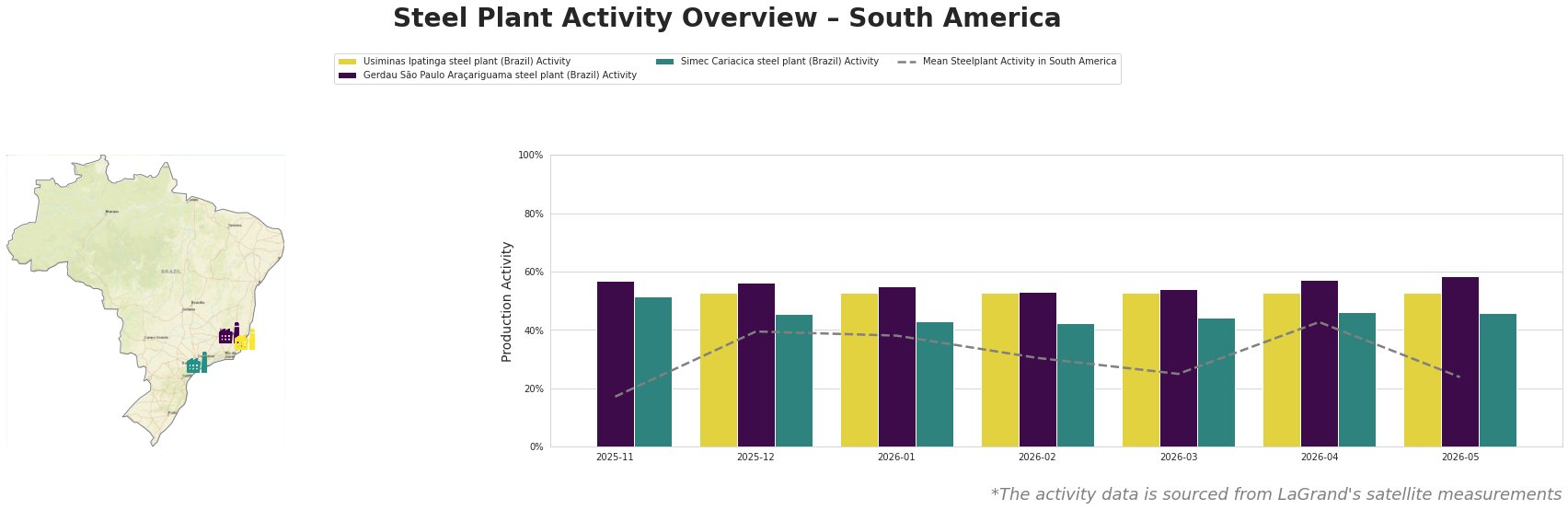
Usiminas Ipatinga’s steady activity level is noteworthy since the plant’s stable production capacity enables significant output capabilities for heavy plates, which saw a *117% increase in exports. Such output positions the plant favorably amidst a domestic market inclined towards local sourcing. Conversely, Gerdau’s uptick to 59% reflects stronger demand for rebar, supported by Brazil’s 12% increase in rebar exports in April due to robust shipments to South American nations as noted in the article “In April Brazil rebar exports rise on stronger shipments to South America, while imports fell on no Egyptian supply.”
Noteworthy supply disruptions in the region could stem from Brazil’s intention to limit imports through antidumping measures, which contributed to an 38.6% drop in import volumes, as articulated in “Brazil’s steel imports begin to decline amid antidumping measures.”
Recommended Actions for Steel Buyers:
1. Prioritize procurement from Usiminas and Gerdau to secure reliable supplies of HDG and rebar, with Usiminas capitalizing on the wave of increased regional exports.
2. Monitor import trends and the impact of antidumping measures to navigate potential supply constraints, particularly for specialized steels.
3. Establish contracts with local producers to capitalize on competitive pricing, ensuring insulation from international market fluctuations.
This analysis underscores the evolving dynamics of Brazil’s steel market characterized primarily by impressive export performances and strategic adaptations shaping procurement strategies.