


From the Field to the Dashboard – Built by Experts, for Experts.
Discover What's Really Happening in the Steel Industry
Use the AI-powered search engine to analyze production activity, market trends, and news faster than ever before.
Try the Free AI Search EngineDeclining Steel Activity in China: Supply Chain Disruptions Loom
China’s steel market sentiment continues to deteriorate amidst rising costs and stagnating demand. The article Prices for coking coal rose in June highlights increasing coal prices due to supply constraints from ongoing mine closures, which are linked to safety inspections following accidents. This coincides with the recent satellite-observed data indicating a significant decline in steel plant activities, particularly at the Cangzhou China Railway Equipment Manufacture Material Co., Ltd., suggesting that such issues are already impacting production levels.
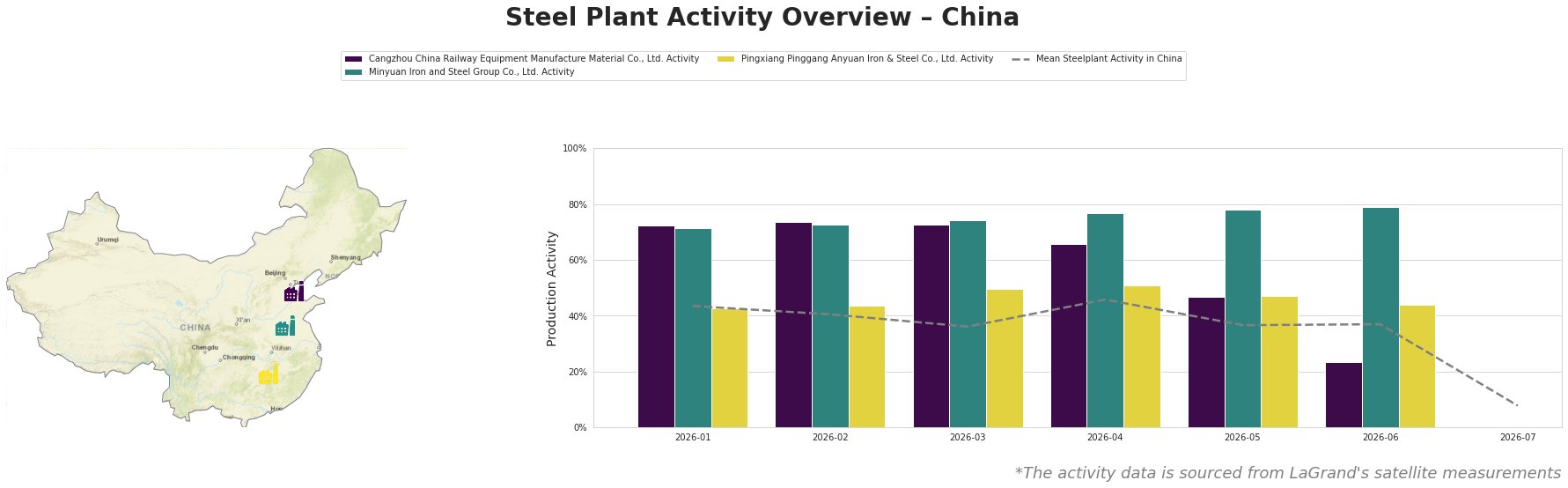
Activity at Cangzhou decreased sharply to 23% in June, reflecting the heightened operational constraints stemming from rising coking coal prices noted in CISA: Coking coal purchase costs in China up 4.54 percent in Jan-May 2026. This suggests that steep input costs are likely curtailing production capabilities significantly. Meanwhile, Minyuan Iron and Steel Group maintained relatively high activity at 79%, but the overall market’s health is underscored by rising inventories, as highlighted in CISA mills’ daily crude steel output up 0.8% in mid-June 2026, stocks also up, reflecting a mismatch between production and consumption.
Similarly, Pingxiang saw slight resilience but remains dependent on broader market conditions for continued performance. Overall, the Mean Steelplant Activity has averaged only 37%, indicating a disconcerting downward trend, especially as geopolitical tensions highlighted in CSC: China production cuts and geopolitical tensions tighten global steel supply, could amplify supply constraints.
Potential supply disruptions are looming as Cangzhou’s activity level indicates an immediate fallout from high-grade coking coal costs and lack of demand. Steel buyers should brace for potential price escalations driven by these supply chain disturbances and consider securing contracts or increasing stock levels in advance to mitigate risk. Focused procurement actions should be tailored toward plants demonstrating stable output, such as Minyuan, while preparing to pivot as purchasing terms with suppliers may evolve rapidly amid tightening supply.