


From the Field to the Dashboard – Built by Experts, for Experts.
Discover What's Really Happening in the Steel Industry
Use the AI-powered search engine to analyze production activity, market trends, and news faster than ever before.
Try the Free AI Search EngineSteel Market Outlook: Positive Trends in Asian Plant Activity Linked to Global Dynamics
Recent activity in the Asian steel industry reflects a very positive market sentiment, driven by robust demand and production advancements. Specifically, the reports titled US plates in coil imports decrease 50.3 percent in April 2026 from March and US structural pipe and tube exports down 4.6 percent in April 2026 from March illustrate global shifts impacting local dynamics. Additionally, satellite-observed data reveals significant trends in major steel plants across Asia, which are likely influenced by these international market changes.
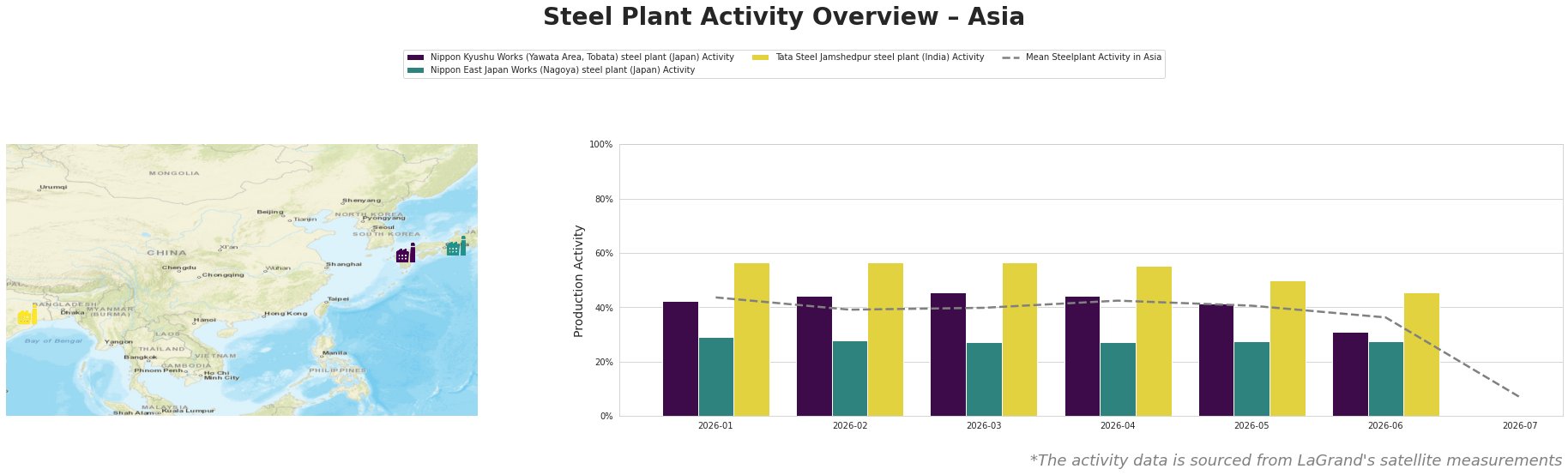
In the case of the Nippon Kyushu Works (Yawata Area, Tobata) steel plant, activity declined to 31% in June 2026 from a peak of 46% in March 2026. While this drop may reflect local adjustments in response to external market pressures, a direct link to specific recent news articles is not evident. This facility emphasizes producing semi-finished and finished rolled products, which may be experiencing fluctuations in demand due to shifting import patterns.
Conversely, Nippon East Japan Works (Nagoya) has maintained a relatively stable activity level between 27% and 29%, suggesting resilience amid external pressures, although specific links to article-driven dynamics remain unclear. It produces significant quantities for the automotive and infrastructure sectors, indicating potential sustained demand as these industries recover.
On the other hand, Tata Steel Jamshedpur shows a gradual decline to 46% in June from a high of 57% in March, which aligns with reduced US exports of structural pipe and tube. As this plant is a major player in the production of finished rolled products, buyers should monitor their sourcing strategies closely, especially given the 4.6% decline noted in US exports, potentially signaling tighter global supply.
The observed activity shifts suggest potential supply disruptions, particularly for Tata Steel Jamshedpur due to declining export prospects. Steel buyers should consider increasing stock ahead of anticipated constraints influenced by the marked reduction in US plate and tube imports, while strategically diversifying suppliers to mitigate risks linked to single-region reliance.
In summary, steel procurement strategies in Asia should be aligned with the international market’s dynamics as evidenced by recent trends in US imports and exports, as these geopolitical shifts will significantly impact local supply and demand curves.