


From the Field to the Dashboard – Built by Experts, for Experts.
Discover What's Really Happening in the Steel Industry
Use the AI-powered search engine to analyze production activity, market trends, and news faster than ever before.
Try the Free AI Search EnginePositive Trends in Asia’s Steel Market: Insights Driven by Recent Activity and Export Data
In Asia, recent developments indicate a positive sentiment in the steel market, particularly driven by shifts observed in plant activity alongside export data. The article “China’s stainless steel exports fell by 30.8% y/y in January–May” highlights a significant decline in China’s stainless steel exports during the first five months of 2026, correlating with a stable activity level at key steel plants but featuring a dip in mean activity overall.
Measured Activity Overview
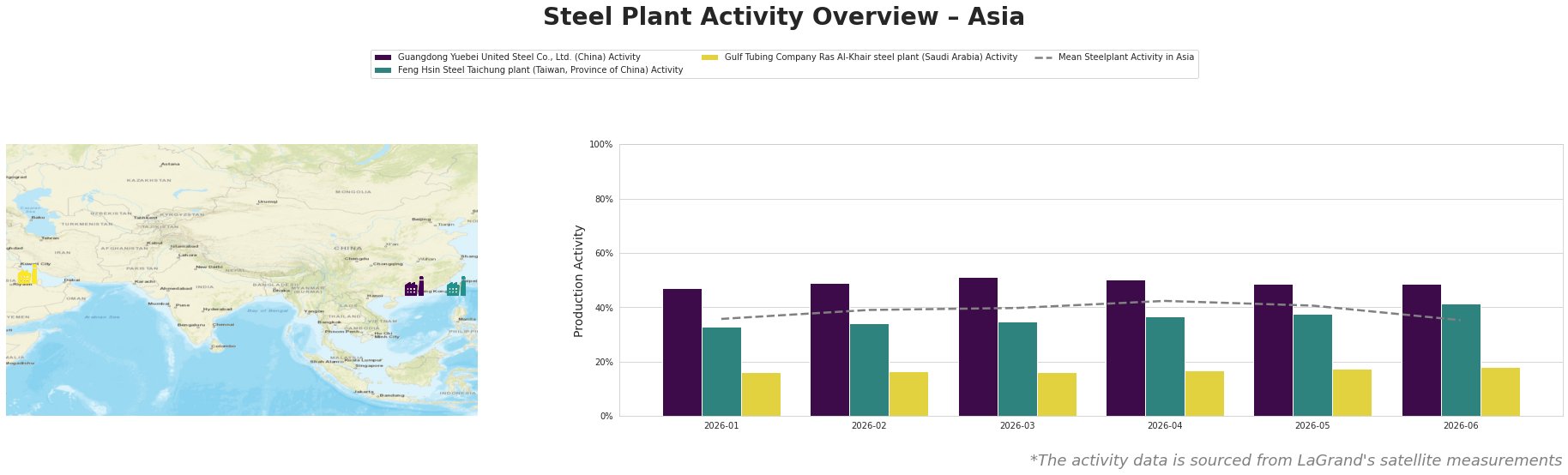
Following a peak in activity in April 2026 with a mean level of 42.0%, there has been a notable decline to 35.0% by June. However, individual plant performances varied significantly; the Feng Hsin Steel Taichung plant demonstrates resilience, increasing from 35.0% in May to 41.0% in June despite broader market trends. No direct connection between these variations and the news of exports could be firmly established, but the fluctuations highlight regional dynamism.
Guangdong Yuebei United Steel Co., Ltd. has maintained a stable activity level around 49.0% in recent months, demonstrating consistent output in finished rolled products like rebar. This stability exists despite external pressures indicated by the export decline in the stainless steel market.
Meanwhile, the Gulf Tubing Company Ras Al-Khair observed a slight increase to 18.0% in June, potentially linked to the uptick in demand for energy and infrastructure products post-pandemic.
Evaluated Market Implications
Given the 30.8% decrease in China’s stainless steel exports, potential supply disruptions in this steel segment may arise, affecting prices and availability. Steel buyers should prepare for potential impacts on procurement costs associated with fluctuations in the stainless steel segment, particularly given the increase in raw materials for other product lines noted in the news.
Recommended Procurement Actions:
1. Diversification: Buyers should consider diversifying their suppliers beyond China to mitigate risks related to export vulnerabilities, especially in stainless steel.
2. Inventory Management: Given the peak activity in Feng Hsin Steel and stable outputs from Guangdong Yuebei, stakeholders should assess purchasing strategies carefully, aligning procurement activities with upcoming production capacity forecasts.
3. Monitoring: Continuous monitoring of activity trends at all mentioned steel plants is recommended to capture real-time changes in supply dynamics.
By adapting their purchasing strategies in response to the described market shifts and insights, steel buyers can better manage risks and optimize their procurement outcomes in an evolving landscape.