


From the Field to the Dashboard – Built by Experts, for Experts.
Discover What's Really Happening in the Steel Industry
Use the AI-powered search engine to analyze production activity, market trends, and news faster than ever before.
Try the Free AI Search EngineAsia Steel Market Update: Neutral Sentiment Prevails Amidst Rising Activity and Overcapacity Concerns
In Asia, the steel market maintains a neutral sentiment as stainless steel production rose 3.3% year-on-year for Q1 2026, according to Global stainless steel production rose 2.5% y/y in Q1. However, a stark disparity in plant activities signals underlying challenges, with the OECD warning of worsening overcapacity in its report, Global steel overcapacity deepens: OECD. Notably, observed data indicates significant drops in activity levels at key steel plants, revealing a complex market landscape.
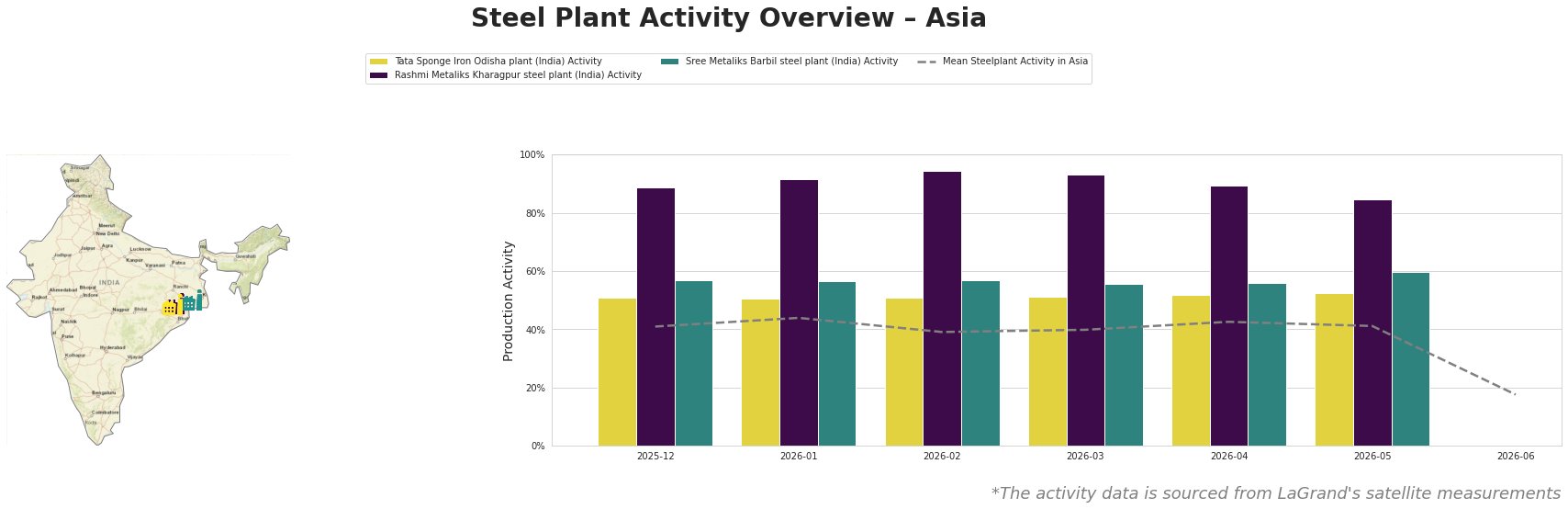
The Mean Steelplant Activity in Asia displayed a steady decline, particularly notable in June at 18.0%. The Tata Sponge Iron Odisha plant maintained relatively consistent activity around 51-52%, aligning closely with rising demand in Global stainless steel production rose 2.5% y/y in Q1, but did not show reactive increases amid overall market pressures. Conversely, the Rashmi Metaliks Kharagpur steel plant experienced a peak at 95.0% in February before tapering to 85.0% in May, illustrating volatility that might link to the weak demand outlined in the OECD steel reports, where overcapacity expectations align with dipping plant performances. The Sree Metaliks Barbil plant’s uptick to 60.0% in May mirrors production efforts amid burgeoning scrap metal consumption, as noted in Global scrap consumption rose by 4.5% y/y in 2025 — BIR.
The Tata Sponge Iron Odisha plant focuses on DRI production, sharing a stable activity trend despite the industry-wide jitters showcased by the OECD. The plant operates at a capacity of 400 tons, with its sustained lower activity reflecting the non-linear demand pressures stemming from the global market analysis. No direct connections were established between Tata’s stable performance and recent articles.
The Rashmi Metaliks Kharagpur plant operates with a capacity of 1500 tons, and reported activity peaks highlight its ability to leverage existing demand effectively. However, the decline after March may stem from the broader market premise of overcapacity affecting pricing and demand as mentioned in OECD: Global steel excess capacity set to reach 745 million mt by 2028.
Sree Metaliks Barbil, with a total capacity of 700 tons, demonstrated a more reactive shift in activity but still reflects broader regional trends without significant production linkages. While its May activity indicates immediate responsiveness to market needs, the drops observed in June showcase uncertainties likely due to overall market saturation risks.
Given the projected overcapacity and encouraged trade measures, steel buyers should maintain a cautious procurement stance, aligning with the Global steel overcapacity deepens: OECD findings urging closer scrutiny on pricing and capacity utilization trends. We recommend that buyers secure contracts quantitatively to capitalize on regional price fluctuations, particularly in plants exhibiting stable activities like Tata Sponge Iron. Additionally, firms should investigate alternate sourcing strategies to navigate risks associated with excess capacity and global supply challenges.