


From the Field to the Dashboard – Built by Experts, for Experts.
Discover What's Really Happening in the Steel Industry
Use the AI-powered search engine to analyze production activity, market trends, and news faster than ever before.
Try the Free AI Search EnginePositive Outlook for Asia’s Steel Market Amid Continued Demand and Infrastructure Growth
Recent trends indicate a robust recovery in the Asian steel market, particularly driven by sustained demand and increasing production expectations. Reports such as Vale sees no signs of a decline in demand on global metals markets – CEO and Steel production in India could rise by 8% y/y in the FY2026/2027 – forecast highlight the resilience of the steel industry, contrasting China’s plateau in production. Satellite activity data from prominent steel plants further underscores positive activity levels across the region.
Recent satellite data shows that the activity at the Atibir Industries steel plant in India remains strong, with a notable activity level of 62% in June 2026, aligning with the forecast growth in Indian steel production. In contrast, WISCO Group Kunming Steel Co., Ltd. plants in China show more variability, as the New District Branch maintained 48% activity while Honghe Iron and Steel Company saw increased activity to 35% in June, but both are below the Indian plant’s performance. The overall mean activity level across observed plants in Asia stood at 34%, indicating a positive sentiment within the sector.
Measured Activity Overview
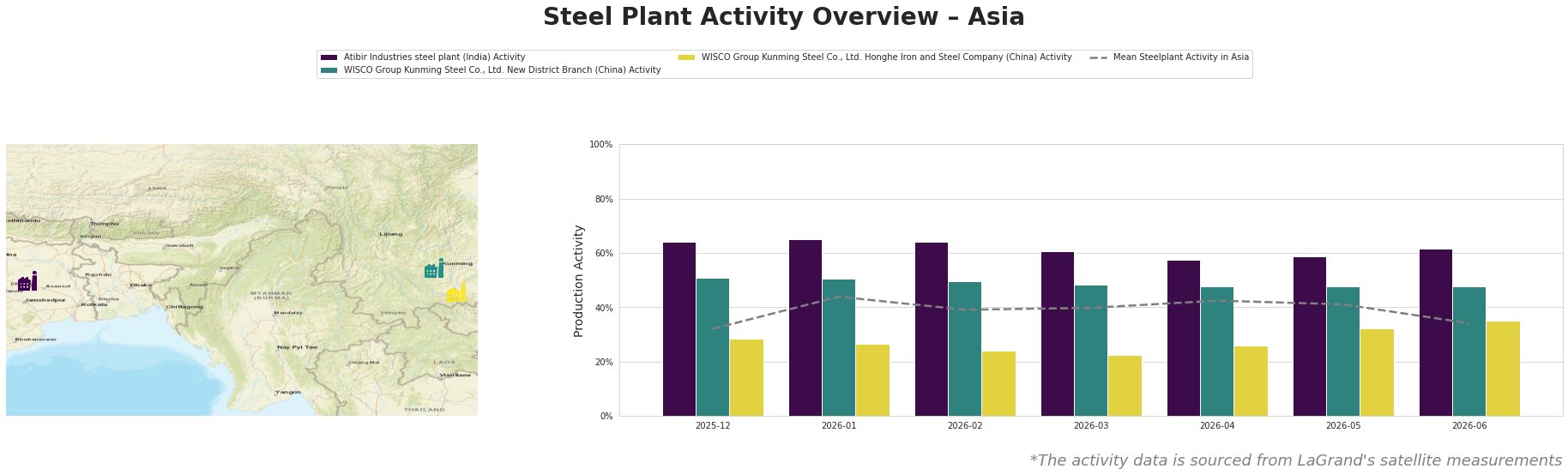
The Atibir Industries steel plant maintains a steady high activity level, reaching 62% in June, in line with India’s optimistic production forecasts driven by government infrastructure projects as per Steel production in India could rise by 8% y/y in the FY2026/2027 – forecast. This plant is pivotal due to its fully integrated processes and strong local demand. On the other hand, WISCO Group Kunming Steel Co., Ltd. New District Branch experienced a lower but stable level at 48%, demonstrating resilience amidst China’s production plateau highlighted in China’s crude steel output down 3.9 percent in January-May 2026, slight rebound in May. The Honghe plant’s increase to 35% activity in June signifies a recovery following the overall industry sentiment, despite challenges in the Chinese market.
Evaluated Market Implications
Steel buyers should consider potential supply disruptions particularly arising from the geographic tensions noted in Vale’s report, which may disrupt raw material flows. With projected steel consumption growth in India and Southeast Asia, buyers in these regions could benefit from securing long-term contracts with Indian producers. Given Vale’s optimism about demand growth in India as indicated in Vale sees strong long-term iron ore demand despite China reaching steel production plateau, it is advised to closely monitor developments in Indian production capacities and invest in multi-supplier strategies.
Surveying activity levels, it’s essential to note that, despite China’s overall steel output reduction, there appears to be a temporary rise that correlates with seasonal peaks, suggesting an initial recovery phase following the operating constraints from earlier in the year. Steel buyers should remain adaptable, leveraging strong performance indicators from India to inform their procurement strategies amid a dynamic regional landscape.