


From the Field to the Dashboard – Built by Experts, for Experts.
Discover What's Really Happening in the Steel Industry
Use the AI-powered search engine to analyze production activity, market trends, and news faster than ever before.
Try the Free AI Search EngineWeakening Italian Steel Market: Demand Declines Amid Holiday-Led Activity Drop
Italy’s steel market faces a negative sentiment driven by high supply levels and weak demand, particularly impacting long products. Notably, “European longs markets mostly stable amid first signs of weakness“ and “European long steel prices stable amid weak demand, low buyer appetite“ highlight a cautious market environment influenced by national holidays that led to reduced activity levels across Italian mills. Satellite data indicates a significant downturn in plant activity, aligning with these reports.
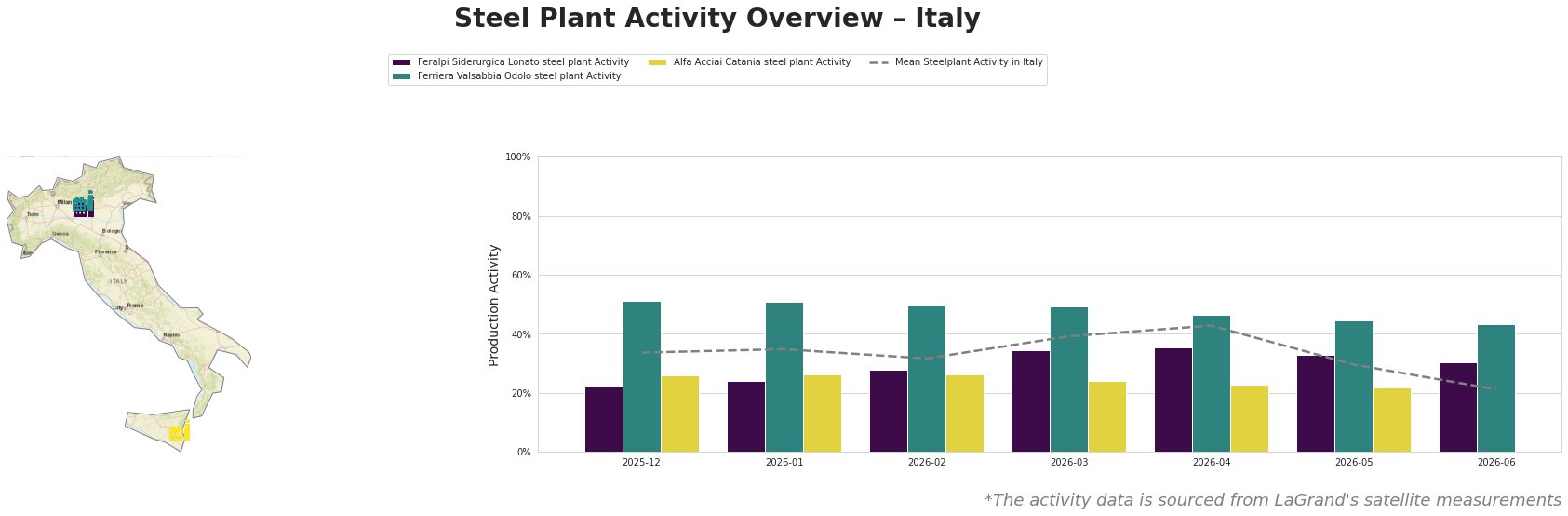
Feralpi Siderurgica Lonato observed a notable decline to 30% activity in June from 33% in May. This aligns with “European longs markets mostly stable amid first signs of weakness,” suggesting reduced operations due to holidays and market instability. Ferriera Valsabbia Odolo’s activity decreased to 43%, signaling further contraction in response to declining demand reflected in “European long position markets are mostly stable amid the first signs of weakness.” Contrastingly, Alfa Acciai Catania maintained a low activity level of 22%, indicative of persistent struggles. The overall trend across these facilities reveals a shift in market dynamics as demand fails to match supply levels.
Feralpi Siderurgica mainly produces finished rolled products using electric arc furnaces (EAF) and has been affected by the weak demand causing its activity decrease. Ferriera Valsabbia, also utilizing EAF, faced a decline related to high supply and cautious purchase behaviors noted in “Prices for European long products are stable against the background of weak demand and low appetite of buyers.” Despite higher production capacity, both plants show activity levels below mean rates, illustrating the significant market challenges. Notably, Alfa Acciai Catania’s output remained constrained, showing 22% activity.
Steel buyers should consider potential supply disruptions, especially from high-capacity plants experiencing reduced operations during this downturn. Focus should be placed on negotiating lower prices as buyers demonstrate a wait-and-see attitude, as referenced in “European long steel prices stable amid weak demand, low buyer appetite.” Evaluating procurement strategies should align with the current context to ensure cost-competitiveness and adaptability in response to fluctuating market conditions.