


From the Field to the Dashboard – Built by Experts, for Experts.
Discover What's Really Happening in the Steel Industry
Use the AI-powered search engine to analyze production activity, market trends, and news faster than ever before.
Try the Free AI Search EngineSteel Market in Asia: Deceleration Signals Heightened Procurement Risks
The Asian steel market is witnessing a notable downtrend, primarily driven by economic challenges in China. Recent reports such as “Deutsche Industrie schwächelt im April” and “BASF-Chef warnt vor neuem Ölpreisschock” highlight a 20% decline in car sales in China, leading to decreased industrial orders and signal a concerning economic outlook. This sentiment is reflected in satellite data showing a dramatic drop in operational activity across key steel plants in the region.
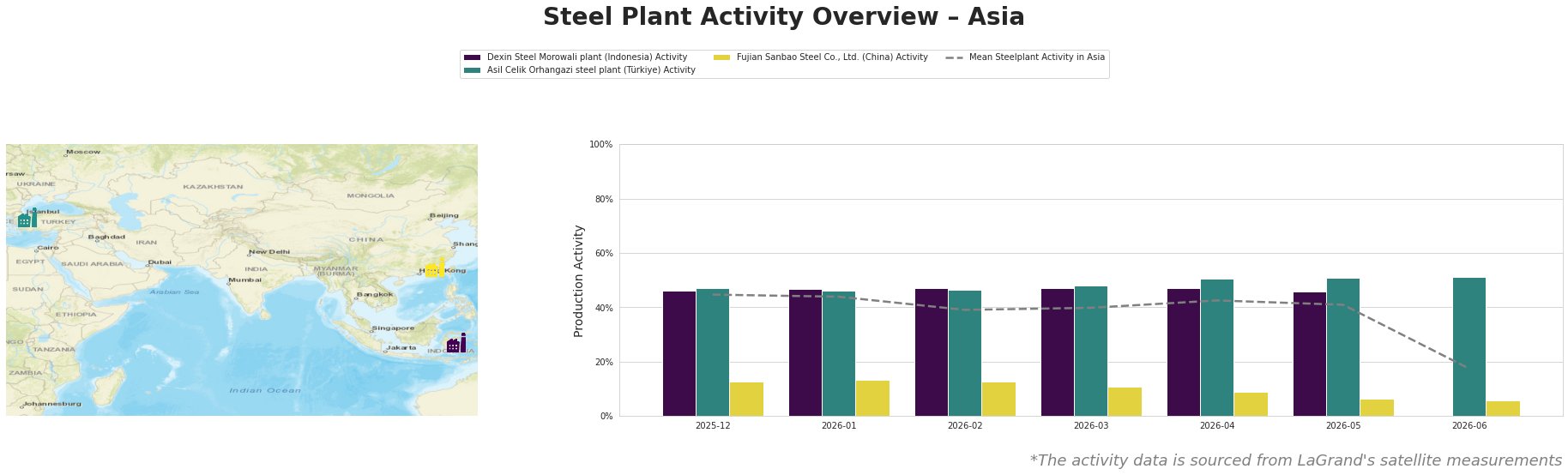
The overall mean activity plunged to 17% in June, significantly lower than historical performance, suggesting widespread instability. Dexin Steel in Indonesia maintained consistent levels around 47% up until May, but the absence of June data limits assessment of response to current pressures. Meanwhile, Asil Celik in Türkiye saw a modest decline but remained formidable at 51% in June, reflecting resilience amid adverse conditions. In stark contrast, Fujian Sanbao Steel exhibited a drastic drop to 6%, affirming an urgent need for review in response strategies, especially considering the interconnected issues highlighted in the articles, including rising costs and decreased industrial demand.
The Dexin Steel Morowali plant, with a capacity of 3,500 tons for crude steel, reported stable activity until June. However, the recent market sentiment suggests an impending decline, possibly linked to the general weakness in industrial orders highlighted in the “Deutsche Industrie schwächelt im April” article, though a direct connection remains unsubstantiated.
Conversely, the Asil Celik Orhangazi steel plant, focusing on electric arc technology with a capacity of 550 tons, showed considerable resilience, aligning its operational dynamics with ongoing infrastructure projects despite broader regional downturns. This is partially substantiated by stable activity levels, yet a thorough reevaluation of buyer strategies in light of potential global supply glitches is advisable.
Fujian Sanbao Steel’s activity decrease correlates with the broader economic downturn exacerbated by “BASF-Chef warnt vor neuem Ölpreisschock,” raising significant procurement concerns for reliance on steel from this plant. The drastic reduction signals an urgent need for buyers to diversify supply sources.
In summary, steel buyers should consider the following actionable strategies:
– Diversify procurement sources: Given the steep decline in activity at Fujian Sanbao, broaden suppliers beyond regions heavily impacted by current economic stresses.
– Monitor production trends: Continuously assess activity levels at Dexin and Asil Celik for early warning signs to adjust purchasing strategies.
– Pre-emptive contracts: Secure agreements now to mitigate potential supply disruptions as evident from the weak industrial outlook across Asia.
Failure to adapt may leave buyers vulnerable to escalating costs and supply chain interruptions in this increasingly negative market climate.