


From the Field to the Dashboard – Built by Experts, for Experts.
Discover What's Really Happening in the Steel Industry
Use the AI-powered search engine to analyze production activity, market trends, and news faster than ever before.
Try the Free AI Search EngineEuropean Steel Market: Positive Outlook as Germany Invests in Decarbonization Initiatives
Recent developments in the European steel market indicate a very positive sentiment driven by significant government investments in decarbonization. Notably, Germany allocates €5 billion for decarbonization of industry (2026-05-07) and the subsequent approval of this funding by the European Commission in Germany’s EUR 5 billion funding plan for industrial decarbonization projects approved (2026-05-10) are crucial for the sector’s evolution. These initiatives enhance competitive stability amid rising global pressures and are expected to encourage increased activity among steel plants.
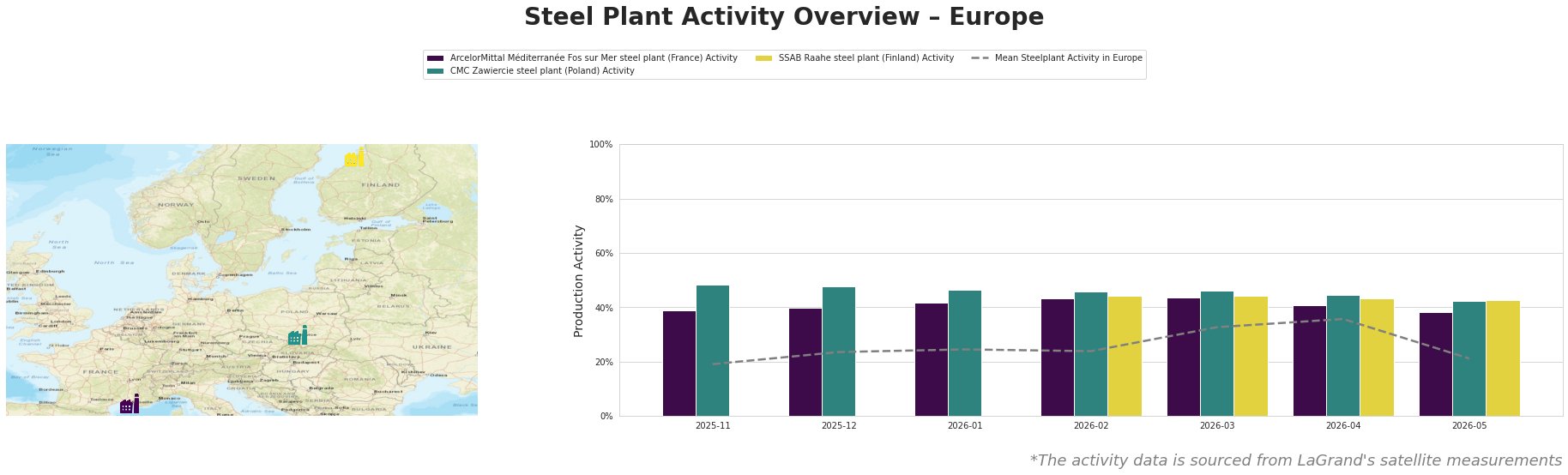
In ArcelorMittal Méditerranée Fos sur Mer (France), activity peaked at 43% in February but experienced a decline to 38% by May, which does not directly align with the recent funding announcements. The primary operations involve integrated processes focusing on semi-finished and finished products intended for diverse sectors including automotive and construction.
CMC Zawiercie (Poland) has shown resilience, maintaining activity levels consistently around 44-48%, suggesting stable demand likely bolstered by a focus on green technology support as indicated in Germany’s EUR 5 billion funding plan for industrial decarbonization projects approved (2026-05-10). Their electric arc furnace technology positions them favorably to capitalize on these environmental initiatives.
SSAB Raahe (Finland) showed stable activity over recent months, fluctuating around 43-44%. While specific decarbonization linkage isn’t established, their planned transition to EAF production aligns with broader market trends discussed in the news.
The proposed updates to the EU ETS (2026-05-11) are particularly strategic as they entail providing increased free allowances, impacting 75% of emissions and directly relating to operational adjustments of all observed plants, particularly benefiting those with higher emissions reductions capabilities.
In conclusion, the increasing financial support for industry decarbonization highlights opportunities for procurement professionals. Strategic recommendations include:
- Procurement Flexibility: Engage with suppliers in Germany poised to adopt green technologies, as they represent a competitive advantage linked to funding efforts.
- Monitor EU ETS Changes: Stay informed about the implications of increased free allowances and their impact on cost structures for suppliers, particularly those in emission-intensive sectors.
- Risk Assessment for ArcelorMittal: Evaluate potential disruptions linked to ArcelorMittal’s operational decline, considering shifts in supply chains that could arise from their conservative activity levels.
Emphasizing targeted procurement strategies will be pivotal for navigating the shifting landscape shaped by these governmental and regulatory factors.