


From the Field to the Dashboard – Built by Experts, for Experts.
Discover What's Really Happening in the Steel Industry
Use the AI-powered search engine to analyze production activity, market trends, and news faster than ever before.
Try the Free AI Search EnginePositive Sentiment Amid Fluctuating Production: Insights from Europe’s Steel Market
Recent developments in the European steel market indicate a resilient outlook despite significant challenges in Ukraine and Russia. Notably, the articles titled “Ukraine saw a 16% m/m decline in rolled steel production in April“ and “Production of finished products in the Russian Federation decreased by 8.1% in April” reflect setbacks in production correlated with satellite activity data revealing a consistent decline in output levels across affected plants.
In April 2026, Donetsksteel’s activity dropped to 25%, linking directly to the production decline reported in Ukraine. The Hüttenwerke Krupp Mannesmann (HKM) plant, however, has maintained robust activity at around 68% despite regional instabilities, which suggests strategic resilience in Germany against the backdrop of decreasing Russian imports and production. Ural Steel displayed a slight activity decline to 42%, mirroring the overall reduction trends observed in the Russian Federation’s production figures.
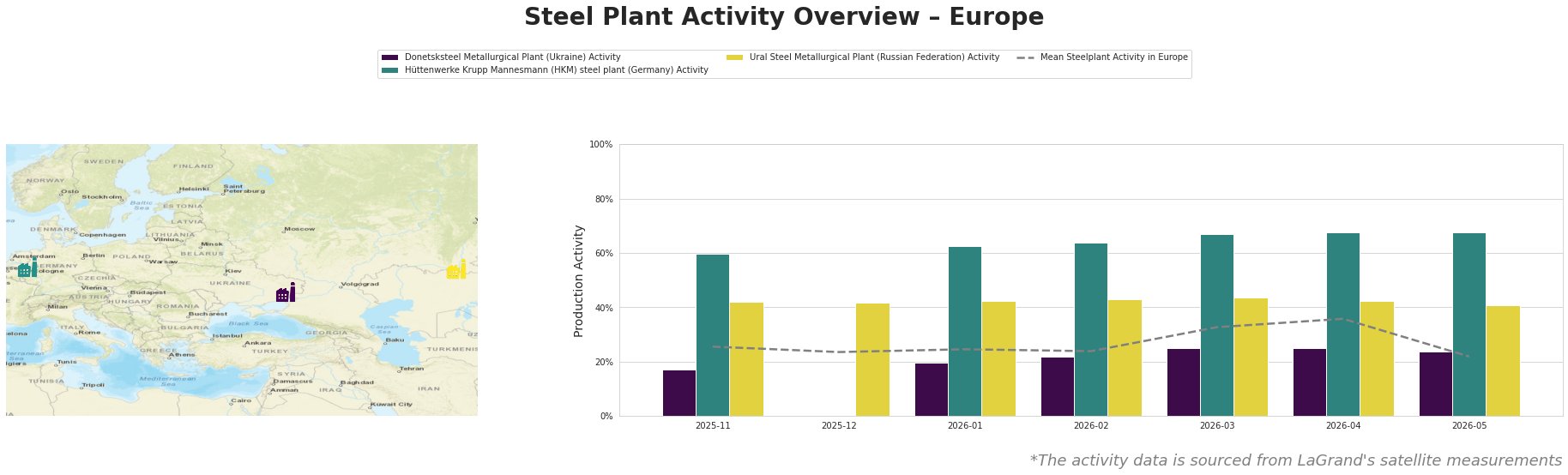
The satellite data indicates an overall mean steelplant activity decline to 22%, concerning but not unexpected given the reductions reported, particularly in Ukraine and the Russian Federation.
The Donetsksteel Metallurgical Plant, with a 25% activity level, has seen operational challenges directly tied to the production drops articulated in “Metallurgists of Ukraine have reduced the production of steel and rolled products in early 2026“. However, its decline is moderated by its focused output on pig iron amid a strained supply environment.
Conversely, the Hüttenwerke Krupp Mannesmann (HKM) plant has exhibited stable performance with 68% activity. Its ability to maintain productivity can be seen positively against the backdrop of increasing Turkish imports, as Russia’s exit creates opportunities for more stable suppliers. HKM’s diversified product offerings can cater to rising demand driven by Turkey’s 73.2% increase in billet imports reported in “Russia and China drive Turkey’s 73.2 percent rise in billet imports in January-March 2026“.
The Ural Steel Metallurgical Plant retains a viable position despite a 42% activity level, echoing regional declines as articulated in the Russian production article.
Given the current landscape marked by production reductions particularly stemming from Ukraine and Russia, buyers are advised to adjust procurement strategies by targeting suppliers showing robust activity, like HKM, to mitigate potential supply disruptions. Establishing relationships with alternative suppliers in Turkey and seeking to leverage strong product offerings there could also stabilize procurement channels amid variable Russian supplies.
In summary, while challenges persist in specific regions, the current activity levels in Europe hint at openings for strategic procurement, particularly for established players that can adapt to changing supply dynamics.