


From the Field to the Dashboard – Built by Experts, for Experts.
Discover What's Really Happening in the Steel Industry
Use the AI-powered search engine to analyze production activity, market trends, and news faster than ever before.
Try the Free AI Search EngineDeclining Steel Production in Sweden: Insights and Implications for Procurement
Sweden is currently facing a downturn in steel production, as highlighted in the news article “Swedish output declines, SSAB to replace key bridge“. November 2025 figures reveal crude steel production dropped to 331,000 tonnes, a 3.2% year-over-year decline, while year-to-date totals reflect a 1.4% decrease from 2024. Additionally, recent satellite data confirms a sharp reduction in activity levels across key steel plants, signaling further challenges.
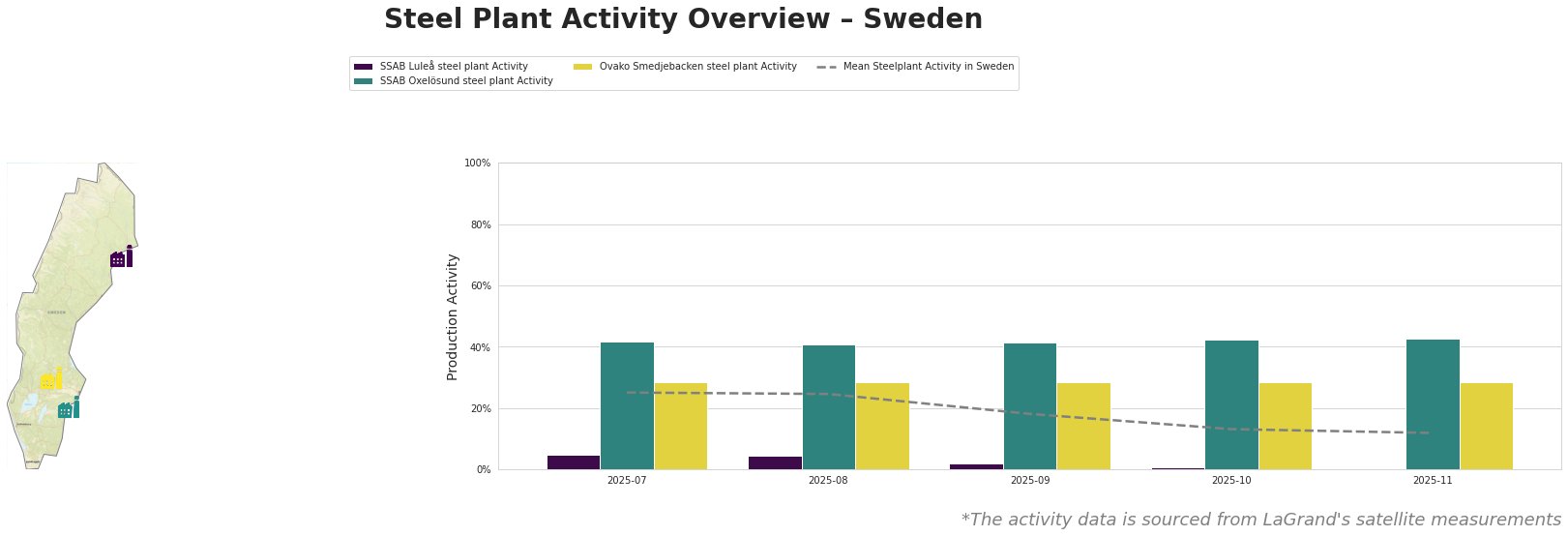
The activity levels show a stark decline, particularly at the SSAB Luleå steel plant, where production plummeted to 1.0% in October from 5.0% in July. SSAB Oxelösund also showed variation, peaking at 43.0% in November but struggling to maintain activity. The Ovako Smedjebacken plant remained relatively stable, with activity levels dropping slightly, suggesting its resilience amidst overall market challenges. There is no direct link between the activity changes at these plants and the July to November production figures detailed in “Swedish production volume is declining, SSAB will replace key bridge“.
SSAB Luleå, which primarily utilizes the integrated production method (BF and BOF), has a capacity of 2.3 million tonnes of crude steel. The significant activity decline, particularly to 1.0% in October, highlights the plant’s struggles amidst the broader market downturn. Meanwhile, SSAB Oxelösund, with a production capacity of 1.5 million tonnes, reflects a fluctuation but overall lower performance indicators. The apparent inactivity at SSAB Luleå could impact supply chains, particularly as the replacement of key infrastructure, such as the bridge described in the news, may contribute to logistical challenges. The Ovako Smedjebacken plant, focused on electric arc furnace (EAF) production, reported a stable operational profile but may face challenges in scaling operations due to lower overall steel demand.
Given this context, procurement professionals should closely monitor supply chain disruptions linked to significant output percentage drops, particularly at SSAB Luleå, which is critical for local markets. Furthermore, it is advisable to secure alternative sources to mitigate risks associated with potential supply interruptions. Engage with Ovako Smedjebacken for specialty steel needs to diversify procurement strategies effectively amidst anticipated market challenges.