


From the Field to the Dashboard – Built by Experts, for Experts.
Discover What's Really Happening in the Steel Industry
Use the AI-powered search engine to analyze production activity, market trends, and news faster than ever before.
Try the Free AI Search EngineSteel Market Update: Europe’s Activity Trends Amid Political Developments (May 2026)
The European steel market is experiencing a Neutral sentiment as observed activity levels fluctuate in response to political dynamics in the region. Recent articles such as “Liveblog Bundespolitik: Forschungsministerium: Arbeiten an Bafög-Erhöhung für dieses Jahr | FAZ“ highlight ongoing political discussions impacting economic confidence, while “Cem Özdemir und Hendrik Wüst Schwarz-Grün in Deutschland?“ signals rising political coalitions, underscoring a backdrop of uncertainty potentially affecting steel demand.
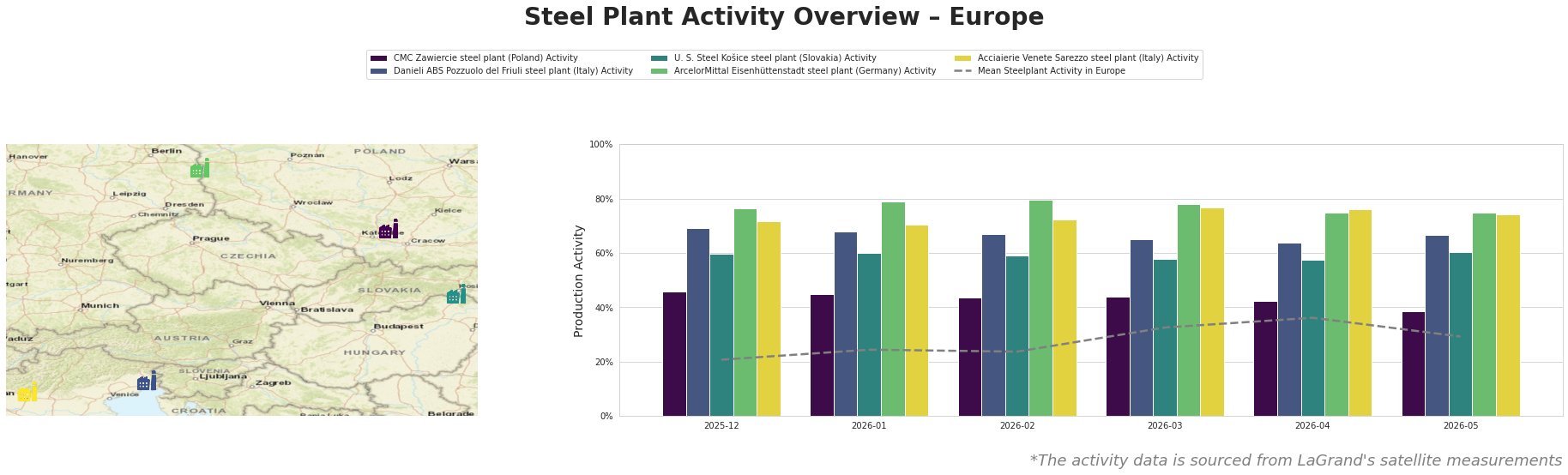
The CMC Zawiercie steel plant in Poland saw a notable drop in activity from 46% in December to 38% in May, a trend not clearly linked to the political discourse highlighted in the articles, indicating a potential internal production issue. Conversely, activity at the Danieli ABS Pozzuolo del Friuli facility remained relatively stable around 67%, reflecting robust demand for rolled products tied to automotive and infrastructure sectors but again without a clear connection to current political events.
The U. S. Steel Košice plant activity has remained comparatively stable at around 60%, aligning with historical performance but bears noting amid increasing regional uncertainties as communicated in “Cem Özdemir und Hendrik Wüst Schwarz-Grün in Deutschland?”. This stability does not guarantee a strong market but reflects a resilience in operations potentially insulated from political shifts.
The ArcelorMittal Eisenhüttenstadt plant’s activity peaked at 80% in February before slightly declining to 75% in May, hinting at a responsive adaptation to fluctuating market demands or potential stock adjustments reflective of political implications as noted previously. Finally, Acciaierie Venete Sarezzo similarly exhibited minor fluctuations around 74%.
Given these insights, steel buyers should consider the following actions:
- Monitor CMC Zawiercie closely for further declines in production, which could indicate longer-term supply issues that might necessitate alternative sourcing strategies to mitigate potential delays.
- Maintain procurement relationships with stable producers like Danieli ABS Pozzuolo to ensure consistent supply, particularly as projects ramp up in automotive and other sectors.
- Leverage U. S. Steel Košice’s stability during uncertain political climates as a reliable option for semi-finished and finished products.
- Prepare for fluctuations in demand stemming from ongoing political negotiations which may influence capacity decisions in the near future, especially for plants like ArcelorMittal Eisenhüttenstadt.
In summary, proactive engagement and strategic sourcing will be essential as the European steel industry navigates these evolving political landscapes and their impact on plant activity.