


From the Field to the Dashboard – Built by Experts, for Experts.
Discover What's Really Happening in the Steel Industry
Use the AI-powered search engine to analyze production activity, market trends, and news faster than ever before.
Try the Free AI Search EngineSteel Market Update: Asia’s Optimism Grows Amid Increased Plant Activity and Strategic Investments
Recent developments in Asia’s steel market indicate a very positive sentiment, driven by substantial investments and enhancements in production capabilities. Notably, U. S. Steel’s announcement in the article titled “U. S. Steel Board Approves Funding for US$350 Million Gary Works Project, Advances Other Projects“ correlates with increased satellite-observed activity, particularly in U.S. steel plants, reflecting an overall enthusiasm in the industry that may spill over to Asia.
Measured Activity Overview
The table below highlights recent activity trends across key steel plants in Asia:
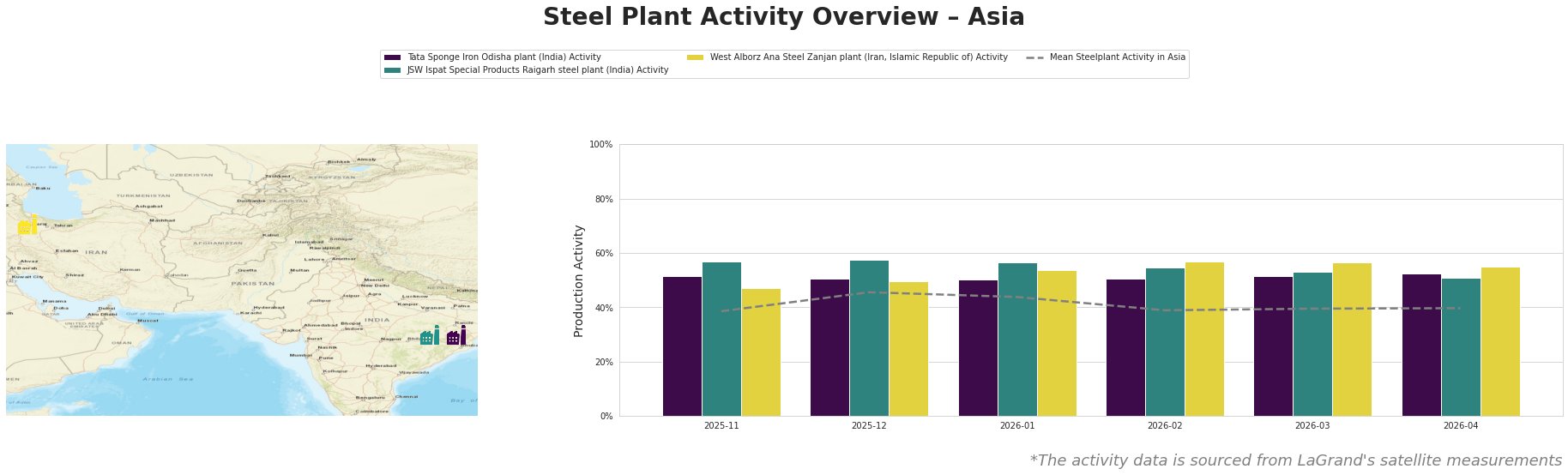
Activity in the Tata Sponge Iron Odisha plant has remained stable around 51-52%, while JSW Ispat notably led with peaks of 57%, reflecting its robust production capabilities. The West Alborz Ana Steel plant also marked a stable performance at around 55-57%, which suggests a favorable operating environment. However, the overall trending mean activity decreased from 46% to 40% over the observed months, indicating potential regional volatility without explicit links to any specific news article.
Plant Narratives
The Tata Sponge Iron Odisha plant has shown consistent performance, primarily producing Direct Reduced Iron (DRI) and operating at activity levels between 51-52%. As no recent direct news connections were established, the activity levels appear stable.
In contrast, the JSW Ispat Special Products Raigarh plant, with a capacity of 1,500 tpa for crude steel and diverse product offerings such as HR plates and rebars, has demonstrated a solid performance with activity peaking at 57%. The resources from U.S. Steel’s investments in advanced facilities, such as the findings from “U. S. Steel to Build US$1.9 Billion DRI Facility at Big River Steel Works,” could signal broader regional dynamics influencing production capabilities in Asian markets lacking direct connections to robust local developments.
The West Alborz Ana Steel Zanjan plant operates with strong activity levels fluctuating between 55-57%, yet like the Tata plant, lacked direct citations linking its performance shifts to the recent news.
Evaluated Market Implications
Potential supply disruptions may arise from weaker-than-anticipated growth linked to the overall market mean decrease. Steel buyers should proactively engage with JSW Ispat due to its higher capacity and stable output, aligning well with U.S. Steel’s advancements creating demand in their operations. Establishing procurement plans that capitalize on JSW’s stable output can help mitigate risks in other regions exhibiting variable activity levels.
Given the evidence of strong confidence through projects like the Mesabi Metallics Secures US$150 Million for American DR-Grade Iron Ore Mine and Pellet Plant, firms should analyze impacts on import strategies and consider local procurement creatively to support their operations effectively.