


From the Field to the Dashboard – Built by Experts, for Experts.
Discover What's Really Happening in the Steel Industry
Use the AI-powered search engine to analyze production activity, market trends, and news faster than ever before.
Try the Free AI Search EngineSharp Rise in Oxygen Steel Production at Duisburg Plant: Analyzing Impacts on the German Steel Market
The ArcelorMittal Duisburg steel plant, located in North Rhine-Westphalia, Germany, has recently reported a significant activity change, with a 15.89% rise in production levels attributed to its Basic Oxygen Furnaces (BOFs). As part of ArcelorMittal’s operations, the plant’s annual production capacity of 1.3 million tonnes includes a range of semi-finished and finished rolled steel products, primarily serving the automotive and machinery sectors.
Recent satellite data shows substantial increases in thermal activity in the plant’s BOFs over the last five months:
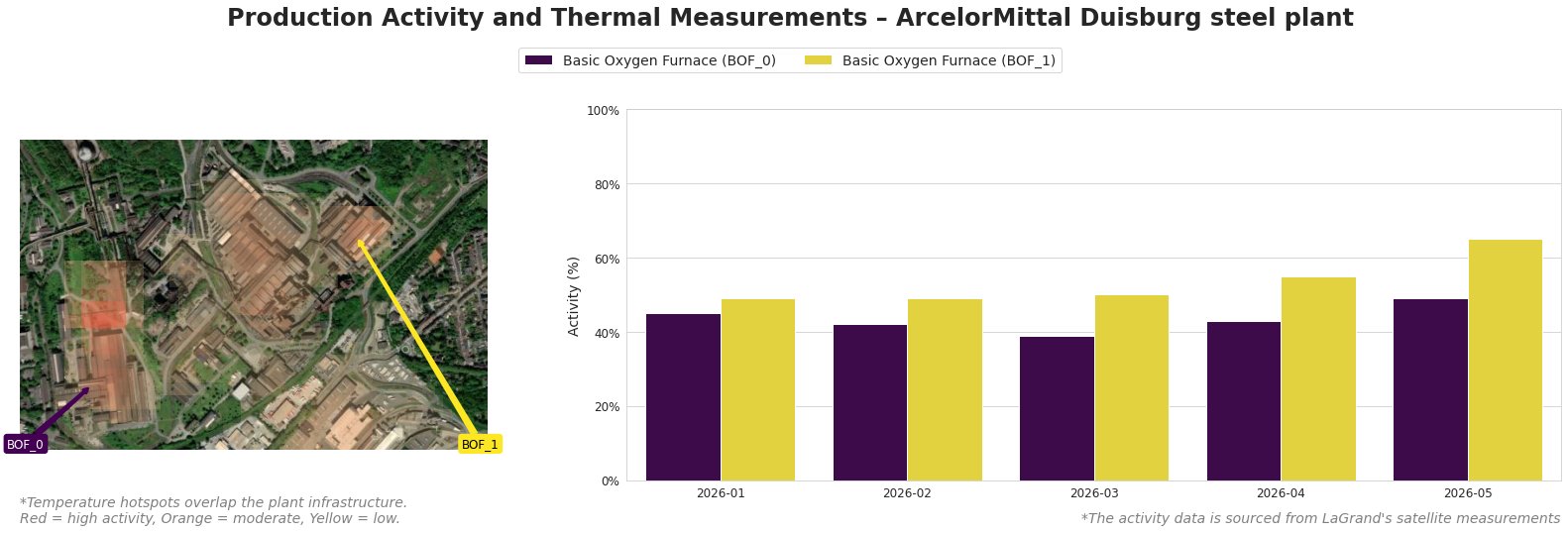
The most notable trend observed is the sharp increase in activity levels for BOF_1, which rose from 50% in March to 65% in May. BOF_0 also demonstrated an upward momentum, increasing from 39% in March to 49% in May. This indicates a robust stabilization in operations, aligning with overall trends in the German steel market.
Market insights indicate that while German crude steel production surged by 9.5% year-on-year in April 2026, overall production levels are still not at full capacity. Notably, the oxygen converter segment is driving this rebound, reflecting broader dynamics mentioned in articles such as Germany increased steel production by 9.5% y/y in April and German crude steel production increased in April.
For steel buyers and market analysts, these trends imply potential supply adjustments, with the rising activity at the Duisburg plant reflecting increased demand in specific sectors. However, the overall steel market remains cautious, as reported by German crude oil production is on the rise, but caution prevails, suggesting that while growth is evident, the industry has not yet fully recovered to necessary profitability levels. This creates both opportunities and risks, particularly for buyers managing inventory against a backdrop of oscillating production levels.