


From the Field to the Dashboard – Built by Experts, for Experts.
Discover What's Really Happening in the Steel Industry
Use the AI-powered search engine to analyze production activity, market trends, and news faster than ever before.
Try the Free AI Search EnginePositive Steel Market Trends in Asia: Insights from Activity Data and Recent Developments
The steel market in Asia is experiencing a positive shift, with notable activity increases across several key plants. Recent developments such as US inflation hits 3-year high in April on war provide economic context, while specific satellite data reveals recent production trends which show promising signs for steel buyers.
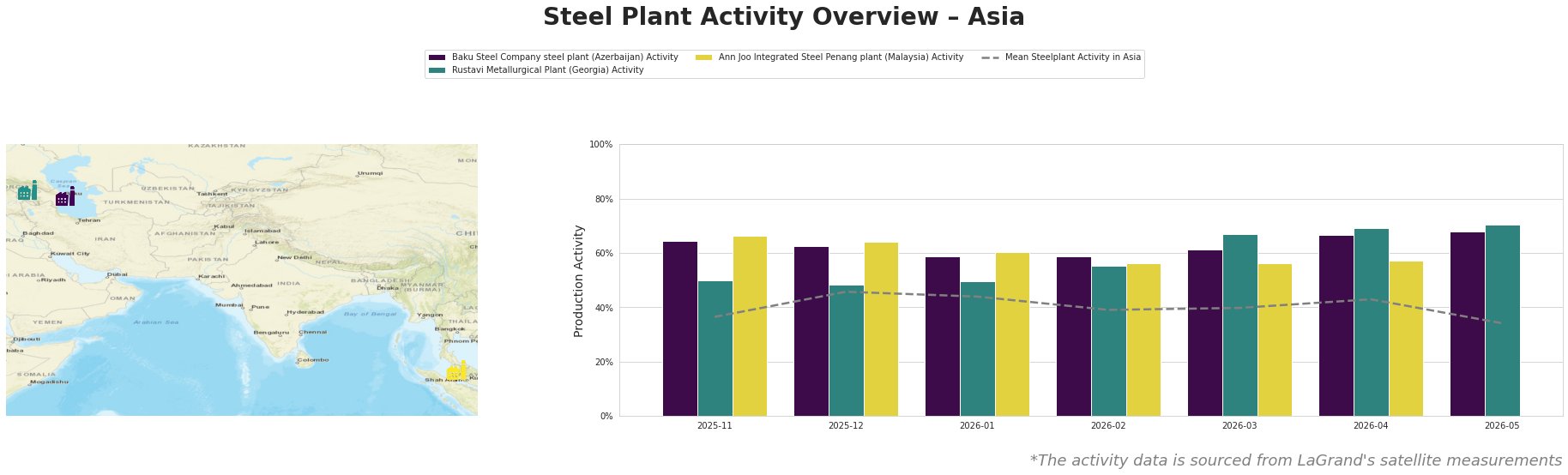
The Baku Steel Company has shown consistent activity levels, peaking at 68% in May, aligning with overall positive sentiment despite marginal fluctuations in the overseas oil market (no direct link established here). The Rustavi Metallurgical Plant reports a peak at 71%, reflecting robust production capabilities, potentially benefiting from ongoing energy demands highlighted by the inflation spike as described in US inflation hits 3-year high in April on war. Activity at Ann Joo remained relatively stable, with May’s performance indicating agility in production resilience despite external pressures.
The Baku Steel Company operates an electric arc furnace (EAF), predominantly producing semi-finished and finished rolled products, which are vital for infrastructure projects. The plant’s capacity utilization reaching 68% in May reflects favorable market conditions, possibly linked to increasing regional demand for construction materials.
In contrast, the Rustavi Metallurgical Plant, with a diversified base utilizing both blast furnace (BF) and electric arc furnace technologies, reported its highest activity level at 71%. This increase positions Rustavi well to meet the rising energy-sector needs highlighted in the inflation discourse, thus directly supporting procurement strategies for suppliers in energy-intensive sectors.
Ann Joo’s recent figure indicates a strong position in the Malaysian market, demonstrating its ability to sustain production levels amidst fluctuating conditions, though a sharper drop in activity from April to May could signal a need for close monitoring.
Given the higher activity levels and market resilience, procurement professionals should consider the following recommendations:
1. Baku Steel Company: Secure longer-term contracts to lock in current favorable rates amidst increasing demand for building materials.
2. Rustavi Metallurgical Plant: Align purchase schedules with anticipated production peaks to leverage lower prices from higher availability in energy-related supply channels.
3. Monitor Ann Joo: Keep a close watch for further activity declines, and engage in flexible contract discussions to manage supply risks effectively.
Given these dynamics, actionable procurement strategies are crucial to navigating the evolving landscape in Asia’s steel market.