


From the Field to the Dashboard – Built by Experts, for Experts.
Discover What's Really Happening in the Steel Industry
Use the AI-powered search engine to analyze production activity, market trends, and news faster than ever before.
Try the Free AI Search EnginePositive Steel Market Outlook in Asia Amid EU Trade Policy Changes
Recent developments in Asia’s steel market reflect a positive sentiment driven by evolving trade discussions with the EU. Specifically, the articles “China is negotiating with the EU regarding the bloc’s new restrictions on steel imports” and “Major EU countries push for tougher trade policy against China” highlight significant negotiations that may reshape trade dynamics, alongside observed changes in steel plant activities.
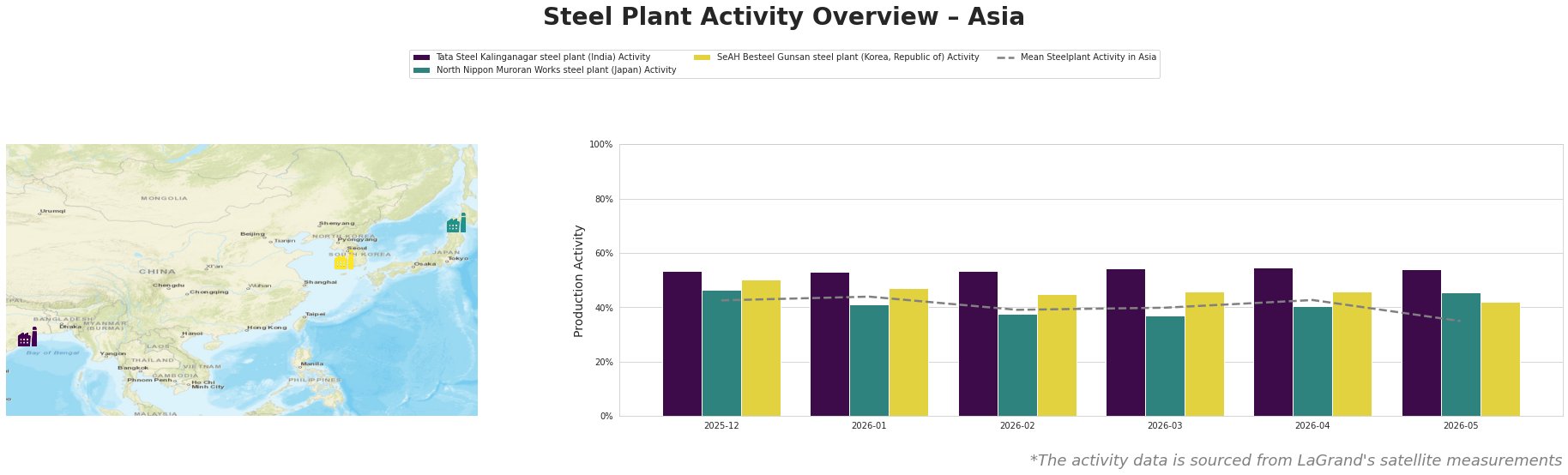
As countries negotiate tighter restrictions on Chinese steel imports, notable shifts in plant activity levels are being observed. The satellite data indicates that the Tata Steel Kalinganagar plant in India remains robust at 54% activity as of May 2026; however, it has seen a decrease from a peak of 55% the previous month. In contrast, activity levels at the North Nippon Muroran Works in Japan are experiencing stability, sitting at 45%, which reflects an increase from 40% in April 2026. Conversely, the SeAH Besteel Gunsan plant in South Korea recently declined to 42%, down from 46% in April, suggesting a dip in operational efficiency.
Activity Trends Overview
Plant Insights
The Tata Steel Kalinganagar steel plant in Odisha remains a significant player, with a maximum observed activity of 55% in April. This facility’s focus on integrated steel production using the BF and BOF methodologies aligns with its consistent output amidst trade tensions highlighted in the aforementioned articles. The recent stabilization at 54% suggests a resilient response to fluctuating import regulations, despite a slight decrease in activity.
In Japan, the North Nippon Muroran Works has adapted well to market conditions, reflecting activity growth to 45%. The plant’s diverse product offerings and robust processes provide it with the agility needed to navigate international negotiations, as discussed in the context of EU policies.
Meanwhile, SeAH Besteel Gunsan has faced challenges with a decline to 42%. This decrease raises potential concerns about competitiveness, particularly in light of the EU’s anticipated quota cuts that may disproportionately affect producers relying on non-domestic sales to Europe.
Market Implications
Given the ongoing negotiations and trade policy developments, potential supply disruptions could occur, primarily impacting plants heavily reliant on exports to Europe, especially those in South Korea and the associated markets. Steel buyers should monitor the outcomes of these discussions closely.
For procurement actions, it is advisable for analysts and buyers to secure contracts focused on Indian and Japanese suppliers, such as Tata Steel Kalinganagar and North Nippon Muroran Works, to mitigate risks associated with reduced availability from affected plants. Promptly assessing the market environment can lead to advantageous positions in upcoming procurement rounds, especially as supply dynamics shift following EU policy changes on Chinese imports.