


From the Field to the Dashboard – Built by Experts, for Experts.
Discover What's Really Happening in the Steel Industry
Use the AI-powered search engine to analyze production activity, market trends, and news faster than ever before.
Try the Free AI Search EnginePositive Outlook for Italy’s Steel Market: Stability and Activity Insights
Italy’s steel market shows a positive sentiment despite broader European weaknesses, largely driven by distinct regional factors. Recent reports from European longs market still weak, new EU CSQs discussed by market players and The European long position market is still weak, market participants are discussing new CSQS in the EU highlight ongoing discussions about EU country-specific quotas (CSQs) impacting supply and pricing dynamics across Europe. Notably, while wire mesh prices surged to €550/mt against stable rebar prices at €440/mt, local manufacturers are expected to adjust capacity to meet potential shortages.
Measured Activity Overview
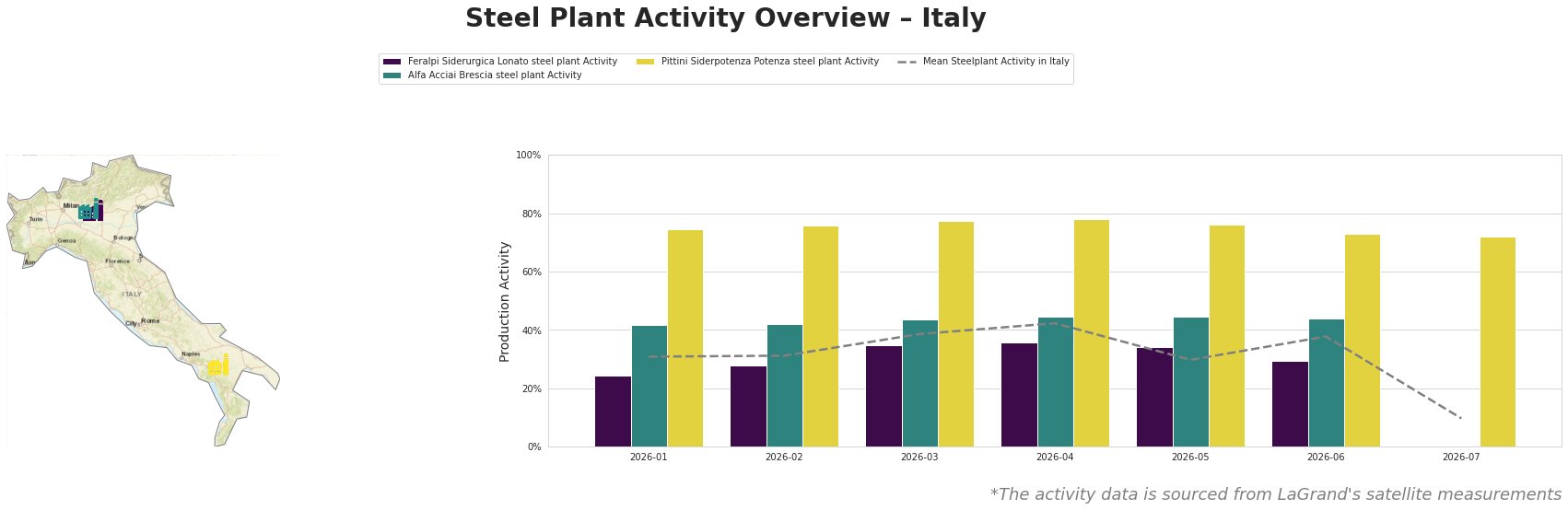
Overall, the mean activity across observed plants significantly dropped in July to 10%, suggesting a decline in operational capacity primarily among lower-performing facilities like Feralpi Siderurgica Lonato, which fell to 0%. In contrast, Pittini Siderpotenza Potenza maintained a relatively stable performance at 72%, emphasizing its resilience amidst market fluctuations. The correlation with the news on supply management and potential import constraints indicates a strategic shift by domestic producers in response to new CSQ dynamics.
Steel Plant Narratives
Feralpi Siderurgica Lonato, located in Brescia, observed a downturn in activity with reported numbers dropping to 0% as of July. This decline may be linked to cautious market sentiment highlighted in the Bulgarian longs market holds steady as new EU quota regime deepens cautious mood, emphasizing liquidity concerns that could be impacting operational decisions.
Alfa Acciai Brescia, also in Brescia, shows a stable activity level around 44% for much of the year but did not report data for July. The recent discussions on EU CSQs may motivate producers here to adjust output as quotas evolve, reflecting a wait-and-see approach amidst fluctuating demand and pricing.
Pittini Siderpotenza Potenza maintained strong activity at 72% in July. This plant’s ability to sustain operations might be an implicit response to increased demand for its primary products, aligned with the more competitive pricing climate discussed in various news outlets.
Evaluated Market Implications
With confirmed activity declines at certain plants and linked substantial changes in pricing strategies from the news coverage, buyers must position their procurement strategies to mitigate risks associated with potential supply gaps. Specifically, the following recommendations arise:
- Focus on maintaining relationships with manufacturers in Brescia, especially those adjusting their capacity in response to new quotas.
- Consider longer lead times for procurement with manufacturers like Feralpi Siderurgica Lonato, which faces uncertain operational capabilities.
- Explore competitive opportunities with Pittini Siderpotenza Potenza, considering its sustained performance and product offerings amidst shifting market dynamics.
These actions will allow steel buyers to navigate potential disruptions while capitalizing on emerging pricing adjustments.