


From the Field to the Dashboard – Built by Experts, for Experts.
Discover What's Really Happening in the Steel Industry
Use the AI-powered search engine to analyze production activity, market trends, and news faster than ever before.
Try the Free AI Search EnginePositive Outlook for Europe’s Steel Market Amid Regulatory Changes
Recent developments in the European steel market indicate an overall positive sentiment despite significant challenges. The article “The EU steel quota will hit Ukrainian steelmakers affected by the war hard – Interpipe CEO“ reveals that new trade barriers on Ukrainian steel imports will create further complications for an already struggling sector. Concurrently, the article “EU debates steel measures’ downstream coverage, Ukraine support“ highlights ongoing discussions among EU member states on how to balance protection for domestic steel industries while considering Ukraine’s critical situation. These developments coincide with notable activity shifts monitored via satellite data across key steel plants in the region.
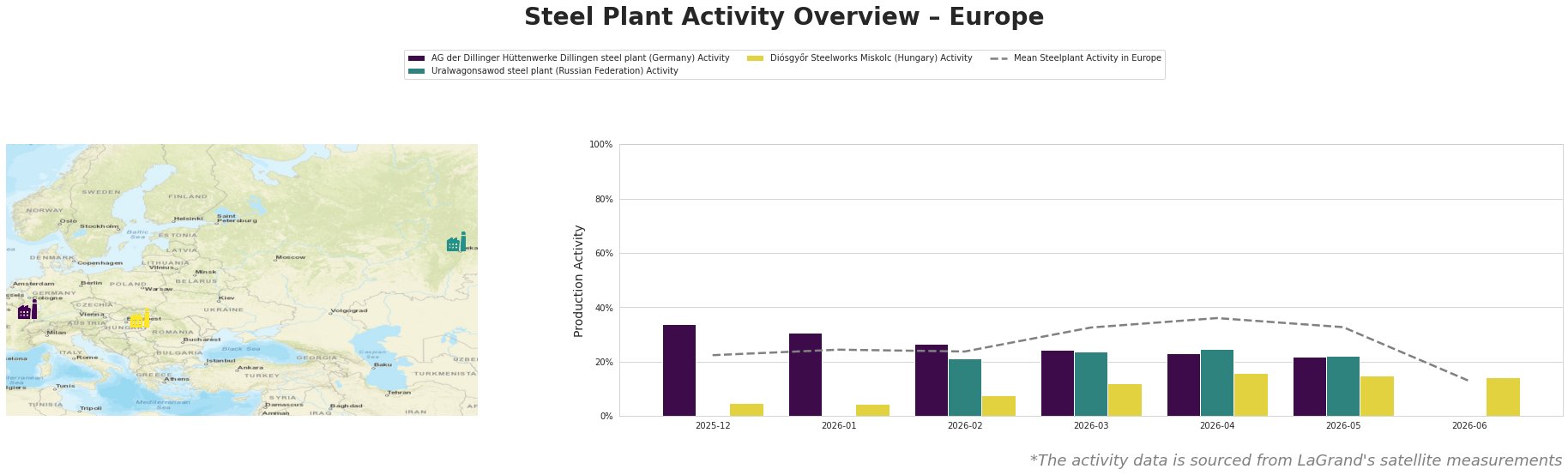
The AG der Dillinger Hüttenwerke Dillingen showed a stable activity level peaking at 34.0% in December 2025 but declining to 22.0% in May 2026. This downward trend aligns with growing regulations affecting steel imports, as highlighted in “EU debates steel measures’ downstream coverage, Ukraine support,” indicating a potential risk for ongoing or future production. The plant primarily produces high-value semi-finished and finished rolled steels essential for automotive, infrastructure, and energy sectors.
In contrast, Diósgyőr Steelworks Miskolc exhibited a modest activity increase from 5.0% in December to 15.0% by May 2026, indicating a stronger performance recently, though still below optimal utilization. The plant’s relevance in supplying construction steels presents an opportunity for buyers to capitalize on increased production amidst market shifts.
The Uralwagonsawod activity, although fluctuating, shows a peak of 25.0% in April 2026 before tapering off, suggesting instability likely exacerbated by geopolitical tensions, as alluded to in “The EU steel quota will hit Ukrainian steelmakers affected by the war hard – Interpipe CEO.” The lack of consistent information about this plant’s workforce and production capacity emphasizes the need for caution among procurement professionals when sourcing from this region.
Overall, ongoing changes in EU regulations regarding steel quotas could soon lead to supply disruptions, particularly affecting Ukrainian producers and their European counterparts. Therefore, steel buyers should consider the following procurement actions:
– Prioritize sourcing from Diósgyőr Steelworks Miskolc to leverage its recovering activity levels for construction projects.
– Monitor AG der Dillinger Hüttenwerke Dillingen closely for any potential deteriorations in output, adjusting procurement strategies accordingly.
Mitigating risks associated with geopolitical instability and regulatory changes while capitalizing on production strengths will be vital for navigating Europe’s evolving steel market landscape.