


From the Field to the Dashboard – Built by Experts, for Experts.
Discover What's Really Happening in the Steel Industry
Use the AI-powered search engine to analyze production activity, market trends, and news faster than ever before.
Try the Free AI Search EnginePositive Momentum in Asia’s Steel Market: Plant Activity Increases Amid Key Investments
Recent developments in the Asian steel market indicate a robust positive shift, particularly driven by infrastructure investments and rising production capacities. The Uzbekistan’s Uzmetkombinat will build a $180 million blast furnace to reduce reliance on imports highlights plans to enhance local production capabilities, especially for hot-rolled steel, set to meet domestic demands. Concurrently, Kazakhstan is building a giant coke plant with the participation of Chinese investors and the establishment of a modern coke facility supports local steel production needs. These initiatives correspond to the observed satellite data showing increased activities at major steel plants in the region.
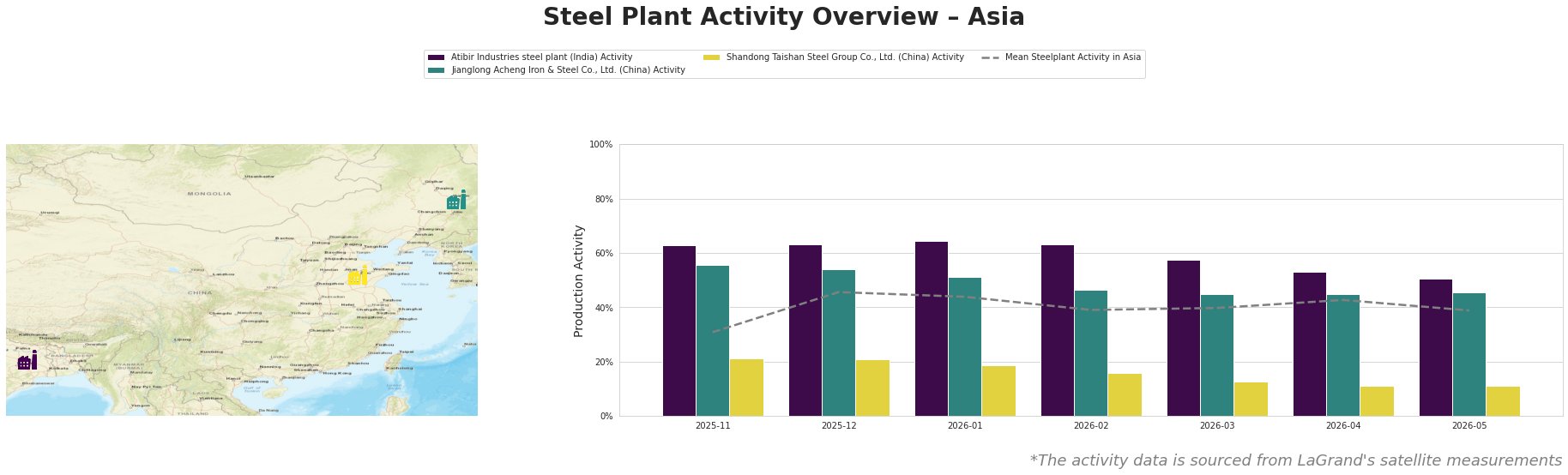
Atibir Industries, displaying a stable activity level around 63%, holds a strong position relative to the mean which fluctuates around 39%. Jianglong Acheng Iron & Steel Co.’s activity is relatively high at 46%, reflecting stability, primarily beneficial given the uptick in steel demand mentioned in Uzbekistan’s Uzmetkombinat will build a $180 million blast furnace to reduce reliance on imports. Meanwhile, Shandong Taishan Steel has seen a notable decline to 11%, likely signaling operational challenges, potentially exacerbated by increasing competition from new entrants in the region.
Atibir Industries has maintained consistency in production, leveraging its integrated production processes and extensive capacities in crude steel, pig iron, and rolled products. The recent external investments in coke production in Kazakhstan bolster regional supply, influencing the buying landscape for steel procurement, although it must address challenges arising from the downward trend in Shandong’s operational output.
Kazakhstan’s newly planned coke facility is anticipated to significantly enhance domestic metallurgical resource availability, aligning with the region’s needs for steel manufacturing capacity, as mentioned in A coke production plant with a capacity of 1 million tons will be built in Kazakhstan. This suggests potential supply chain improvements for buyers but may also catalyze heightened competition for resources and pricing adjustments.
Steel buyers should strategically consider the implications of these investments and varying operational capacities. Specifically, they should monitor:
- Atibir Industries for stable procurement of semi-finished and finished products given its high operational activity.
- Jianglong Acheng for consistent offerings in automotive and machinery steel, addressing specific end-user demands.
- A contingency procurement strategy aimed at Shandong Taishan Steel due to its lower activity, which may lead to shortages in their specific steel products.
The information from US becomes Turkey’s top coking coal supplier as imports rise 22.8 percent in January-March 2026 highlights shifting supply dynamics that could further influence pricing and availability of metallurgical inputs crucial for Asian steel producers.