


From the Field to the Dashboard – Built by Experts, for Experts.
Discover What's Really Happening in the Steel Industry
Use the AI-powered search engine to analyze production activity, market trends, and news faster than ever before.
Try the Free AI Search EnginePositive Momentum in Asia’s Steel Market Amid Quota Challenges for Turkey and Vietnam
The Asian steel market exhibits a positive outlook driven by substantial plant activity, despite challenges facing Turkey and Vietnam, as highlighted in EU Human Rights Commission tightens requirements for Turkey, Vietnam. This article underscores the significant quota reductions for hot rolled sheet and long products in these regions, with Turkey and Vietnam experiencing near-exhaustion of their allocations, notably impacting market dynamics.
Measured Activity Overview
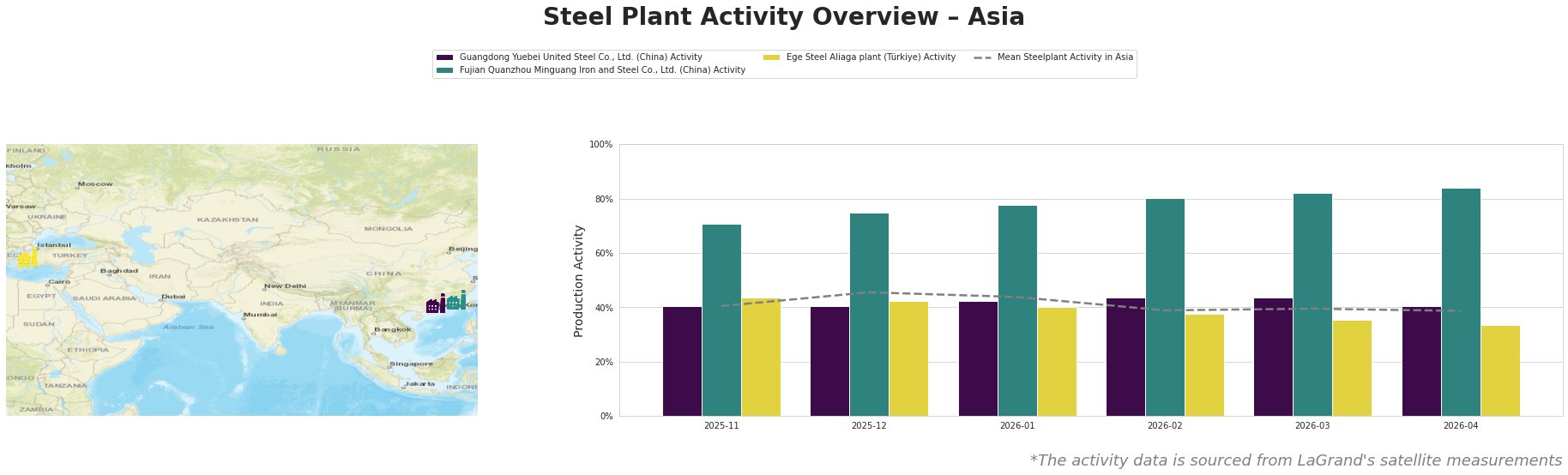
Activity across steel plants demonstrates mixed trends. Fujian Quanzhou Minguang Iron and Steel Co. exhibits strong performance, peaking at 84% in April, potentially linked to robust domestic demand, as China is managing quota efficiently per Türkiye, China lead EU’s second-quarter longs TRQ drawdown. However, Guangdong Yuebei’s activity dipped slightly to 41%, and Ege Steel’s performance also declined to 34%, suggesting challenges amid fluctuating market conditions, though these shifts do not directly correlate with recent quota news.
Guangdong Yuebei produces rebar and operates integrated (BF) processes. Its activity remains close to the average, indicating stable production amidst external pressures. In contrast, Fujian Quanzhou actively utilizes its capacity for finished rolled products, thus maintaining heightened levels even with the backdrop of tighter quota constraints in the region. Ege Steel, primarily focused on electric processes, reflects broader market constraints, as its activity has decreased, tracking closely with evolving market demands without direct linkage to the current news.
Evaluated Market Implications
With Turkey and Vietnam facing reduced quotas, notably reflected in recent articles, buyers should be cautious about potential supply disruptions, particularly for long products like rebar, where Turkey leads utilization efficiently. To mitigate risks, steel buyers should prioritize procurement from China’s Fujian Quanzhou Minguang, benefiting from its high activity (84% in April) compared to competitors constrained by quota limitations.
For steel buyers, it is recommended to secure orders now to avoid future supply shortages, especially for Turkish and Vietnamese products, which may spike in prices due to limited availability. Additionally, actively monitoring shifts in activity among plants can yield insights for tactical purchasing decisions, ensuring preparedness against possible disruptions as the market evolves.