


From the Field to the Dashboard – Built by Experts, for Experts.
Discover What's Really Happening in the Steel Industry
Use the AI-powered search engine to analyze production activity, market trends, and news faster than ever before.
Try the Free AI Search EngineOceania Steel Market Update: Stabilizing Demand Amidst Regional Activity Fluctuations
Recent activity in Oceania’s steel market reflects a Neutral sentiment, with notable shifts in performance across key plants linked to broader trends in global pricing and demand. Notably, articles such as Restrained trade keeps domestic HRC prices in Europe generally stable and European HRC prices are declining due to weak demand and sufficient inventories, but factories expect prices to recover indicate limited trading and weak demand conditions that resonate with observed fluctuations in plant activity across the region.
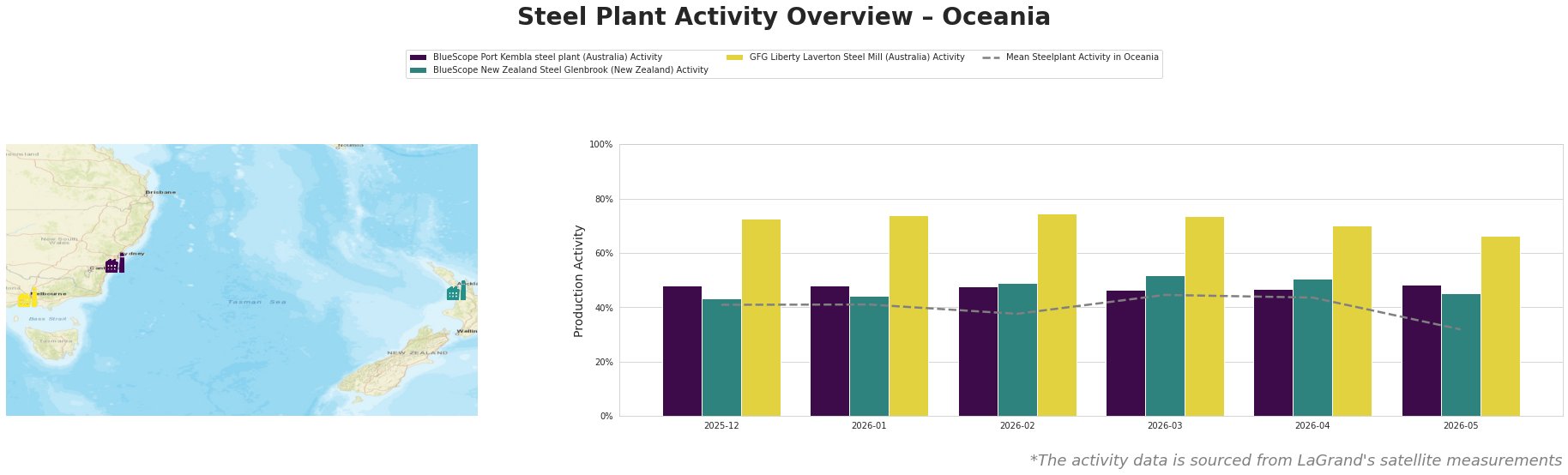
The latest data shows a pronounced decline in mean steel plant activity in Oceania, dropping to 32% in May 2026. GFG Liberty Laverton, which operates with an Electric Arc Furnace (EAF) technology and offers semi-finished products, observed a decline to 66%, down from 73% earlier, indicating a potential mismatch between production capabilities and market demand. Meanwhile, BlueScope Port Kembla has maintained steady output levels at 48%, consistent with its integrated production approach, despite the overall market downturn. In contrast, BlueScope New Zealand Steel Glenbrook showed a slight drop to 45%, reflecting increased competition for finished rolled products within the construction sector.
The pointed connections between weak demand highlighted by articles like European steel HRC prices rise, trading limited and observed activity drops in Oceania, particularly at GFG Liberty Laverton, illustrate a correlation of broader sentiment impacting local decision-making.
Supply disruptions could arise from the prevailing low demand and restrained activity levels at GFG Liberty Laverton. Steel buyers should proceed with caution, particularly given the potential for tightening supply if geopolitical tensions escalate further. Therefore, it is advisable to secure commitments on upcoming purchases while stock levels are sufficient.
Steel procurement professionals are recommended to:
– Monitor pricing trends closely, especially for products like hot-rolled coils, as indicated by European HRC steel prices are rising, trade is limited. Anticipating price fluctuations can inform better negotiation strategies.
– Evaluate inventory levels proactively to avoid potential shortages prompted by the projected demand recovery anticipated by producers in the coming months.
– Consider diversifying suppliers to mitigate risk associated with single-source dependencies, particularly amid uncertainties posed by geopolitical factors.
These actions are critical to navigating the current market landscape effectively and ensuring resilient supply chain management in Oceania’s steel sector.