


From the Field to the Dashboard – Built by Experts, for Experts.
Discover What's Really Happening in the Steel Industry
Use the AI-powered search engine to analyze production activity, market trends, and news faster than ever before.
Try the Free AI Search EngineNeutral Steel Market Outlook for Norway: Regulatory Changes and Activity Trends
Recent news from the EU outlines significant regulatory shifts regarding steel imports, particularly highlighted in “The European Council describes in detail the amendments to the trade regime” and “EU announces new steel import quotas and changes in their application.” These changes aim to combat global overcapacity but importantly, they exempt Norway from certain tariff impacts. While the Celsa Nordic steel plant maintains stable activity levels, recent developments suggest potential shifts in procurement strategies for buyers.
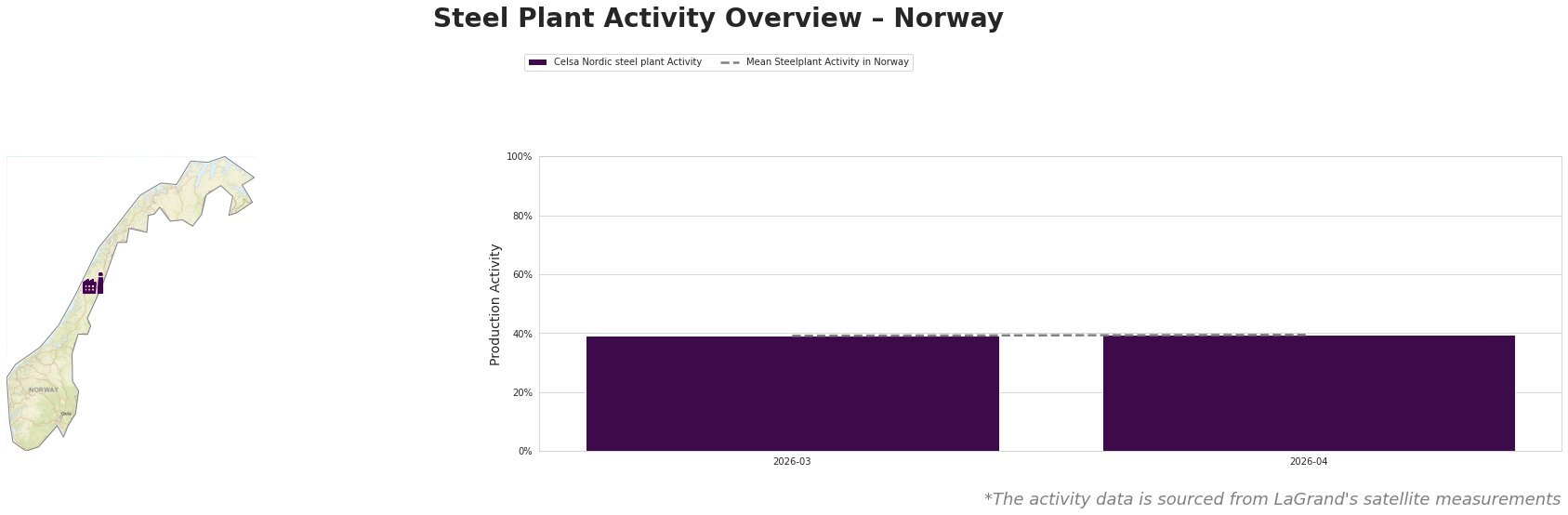
The Celsa Nordic steel plant has shown stable performance, with consistent activity recorded at 39% of capacity in March and April 2026. This aligns with the broader mean activity across Norwegian steel plants, indicating no immediate operational disruptions or significant shifts. Notably, these trends coincide with the EU’s regulatory announcements, particularly concerning quotas and tariffs, which envisage maintaining duty-free imports for Norway.
Celsa Nordic, located in Mo i Rana, specializes in electric arc furnace (EAF) technology, producing semi-finished and finished rolled products primarily used in construction. With a workforce of 340, its production capacity adjusts depending on market dynamics. The stability in the plant’s output suggests resilience against the broader regulatory environment affecting non-EU imports.
Potential supply disruptions may arise post-July 2026 as new quotas take effect; however, Norway is currently exempt from this tariff regime. Steel buyers should consider securing contracts with domestic suppliers like Celsa Nordic to mitigate risks from potential future regulatory changes in the EU market, especially given the ongoing scrutiny of import volumes and the intention to reduce Russian steel dependency.
Justification for procurement decisions should focus on maintaining relationships with stable producers while closely monitoring any shifts in EU regulations that could indirectly affect regional buying strategies. Key recommendations for procurement teams include:
- Confirming long-term contracts with Norwegian suppliers to ensure supply security amidst changing EU landscapes.
- Actively monitoring the outlined EU import procedures and evaluating their potential impacts on future steel pricing and availability.