


From the Field to the Dashboard – Built by Experts, for Experts.
Discover What's Really Happening in the Steel Industry
Use the AI-powered search engine to analyze production activity, market trends, and news faster than ever before.
Try the Free AI Search EngineEurope’s Steel Market Outlook: Positive Trends Amid Rising Plant Activity
Recent developments in Europe’s steel market indicate a very positive outlook, driven by notable increases in plant activity. Key observations correlated with market dynamics are detailed in recent news articles, including “Australia’s Amplitude to buy 50pc of Artisan gas field” and “Union pauses strikes at Australia’s Ichthys LNG: Update”, both highlighting strategic shifts in resource management and operational stability that signal enhanced energy security and operational efficiency for steel producers.
In Europe, satellite data reveals a rising trend in steel plant activity, showcasing individual plant performance against the regional mean. While the Mean Steelplant Activity stabilized at 32.0% as of May 31, 2026, specific plants exhibited divergent trends.
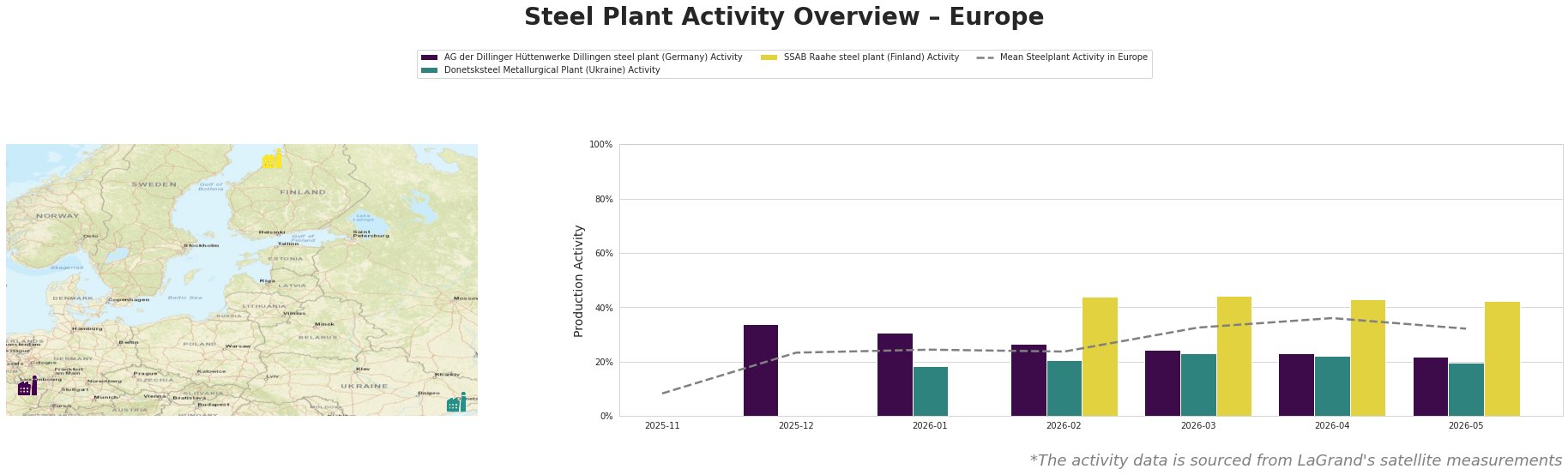
AG der Dillinger Hüttenwerke in Germany recorded a drop from 34.0% in December to 22.0% by May, suggesting operational challenges that may require attention but do not connect to any specific news. Conversely, the SSAB Raahe steel plant in Finland displayed relatively stable activity, maintaining around 42%, underscoring its operational resilience.
The Donetsksteel Metallurgical Plant presents significant concerns with activity levels remaining low, at only 20%. Given its fragile operational status bolstered by geopolitical instability, it poses a risk for supply continuity.
Actionable insights for steel procurement professionals:
1. Increase Inventory: Buyers should consider increasing their inventory levels in anticipation of potential supply disruptions, particularly for products that may rely on Donetsksteel.
2. Monitor Operational Capacity: Focus on suppliers like SSAB that show stable operational metrics, as their ability to fulfill orders may be more reliable than those facing declines, such as Dillinger.
3. Leverage Stable Producers: Engaging more closely with plants showing stable outputs can mitigate risks associated with lower-performing facilities, especially during uncertain periods in the market.
Continued vigilance and proactive procurement strategies will be crucial in navigating this favorable but fluctuating market landscape.