


From the Field to the Dashboard – Built by Experts, for Experts.
Discover What's Really Happening in the Steel Industry
Use the AI-powered search engine to analyze production activity, market trends, and news faster than ever before.
Try the Free AI Search EnginePositive Steel Market Outlook in Asia as Operations Stabilize
Recent activity in the Asian steel market indicates a cautiously optimistic sentiment, particularly following geopolitical developments. The announcement of the US-Iran agreement to end hostilities ‘complete’ (2026-06-13) has led to shifts in operational levels among major steel plants. While stability in oil prices has been observed, vessel traffic through the Strait of Hormuz has not yet reflected significant change, as noted in the article Hormuz tanker traffic unchanged after US‑Iran deal (2026-06-14).
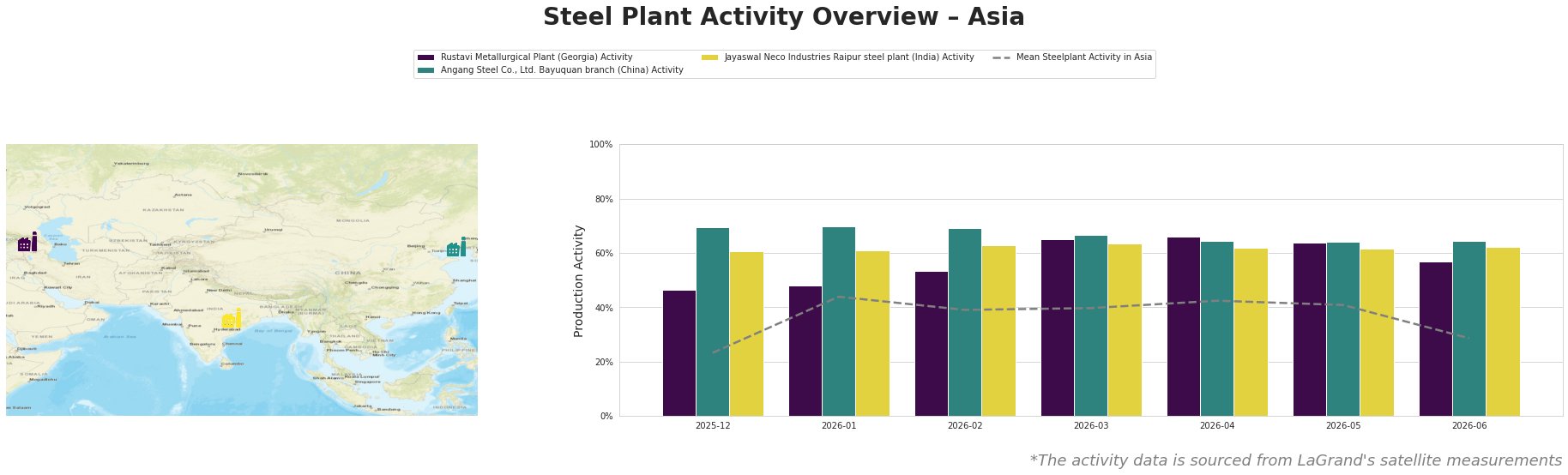
The overall mean activity observed across Asian steel plants saw fluctuations peaking in January (44%) before a decline attributed to operational reassessments post-agreement announcements. The Rustavi Metallurgical Plant maintained higher operational rates, peaking at 66% in April but settling at 57% in June, possibly aligning with neighborhood geopolitical tensions but still reflecting favorable production conditions. In contrast, Angang Steel Co., Ltd.’s activity has held relatively stable, topping 70% in January and reflecting a steady output with 64% in June.
The Jayaswal Neco Industries plant showed a modest increase, registering 63% in February, but has seen a slight dip to 62% in June, suggesting stable but cautious output amid supply uncertainties. No direct connections with external news articles can be established regarding these activity levels.
With a positive market outlook, potential supply disruptions may arise if geopolitical tensions affect operational consistency, mainly in the Strait of Hormuz, crucial for shipping logistics. Procurement actions for steel buyers should focus on securing contracts with plants like Angang and Rustavi, where activity levels remain robust, particularly as geopolitical conditions stabilize and supply routes potentially normalize. Companies should also consider diversifying supply sources to mitigate risks stemming from regional instability highlighted in the articles Shipowners remain cautious on US-Iran deal announcement (2026-06-14) and Trump Iran framework gambles on diplomacy despite warning Tehran will ‘lie and cheat’ (2026-06-18).