


From the Field to the Dashboard – Built by Experts, for Experts.
Discover What's Really Happening in the Steel Industry
Use the AI-powered search engine to analyze production activity, market trends, and news faster than ever before.
Try the Free AI Search EngineEuropean Steel Market: Strong Growth Drives Prospects Amid New Regulatory Framework
The European steel market is experiencing a very positive sentiment driven by recent regulatory changes. Notably, the article European Council details trade regime amendments outlines key alterations to the steel trade regulations, establishing an annual import quota and increased duties on out-of-quota imports. This framework aligns with observed increases in activity at several steel plants, particularly in April 2026, after the regulatory drafts were announced.
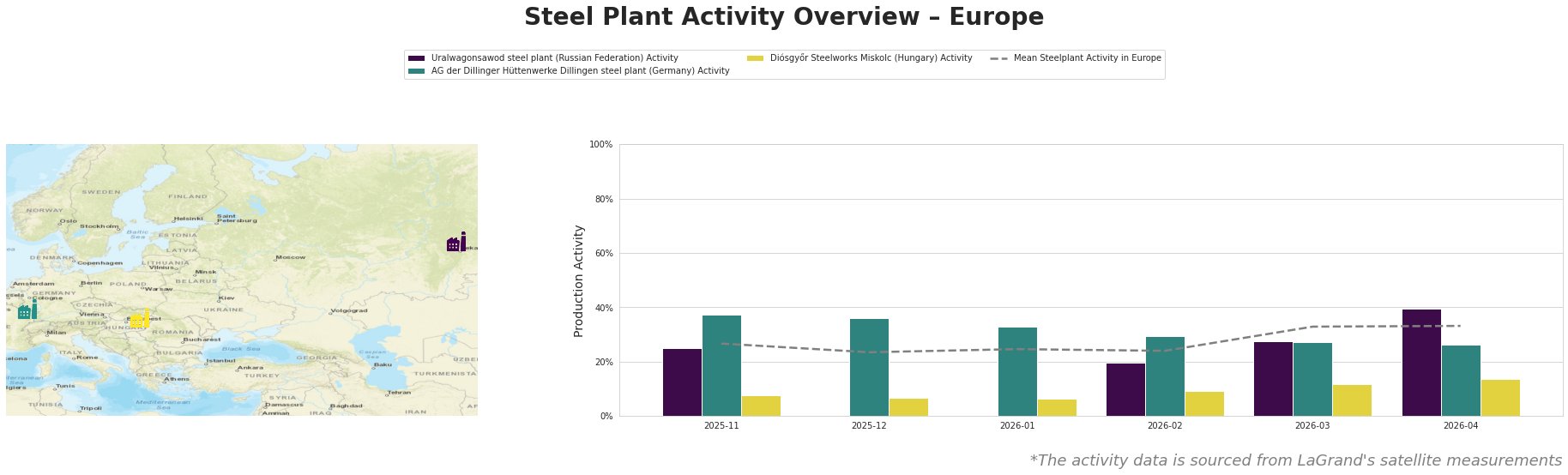
April 2026 marked a significant jump in activity, with Uralwagonsawod output rising to 40%, likely spurred by the impending changes in the regulatory landscape as discussed in multiple articles including Final EU steel trade framework draft keeps carry-over and The European Council has issued a statement on new protective measures in the steel market. Conversely, AG der Dillinger Hüttenwerke saw a slight decrease to 26%, despite being the highest activity plant in prior months, reflecting potential market adjustments ahead of new tariffs. On the lower end, Diósgyőr Steelworks consistently remains below the mean, achieving only 14% activity, with no established connection to recent news changes.
The Uralwagonsawod steel plant in Rostov practices methods typical of Russian production but lacks transparency in operational capabilities. It had a notable 13% increase from March to April 2026, potentially impacted by the announcements regarding trade safeguards. However, no direct linkage to specific regulatory implications can be confirmed from the news.
AG der Dillinger Hüttenwerke, located in Saarland, boasts a sophisticated integrated production process and achieved a peak of 37% in November 2025, but activity fluctuated to 26% by April 2026, possibly reacting to market anticipation of new import quotas as outlined in the European Council details trade regime amendments.
Diósgyőr Steelworks continues to operate primarily via electric arc furnace (EAF) technology, exhibiting a minimal 14% activity in April 2026, far below the mean. The lack of connections to regulatory shifts suggests internal challenges that delineate it from the overall positive market trend.
The recent regulatory changes may exacerbate supply issues for less active plants like Diósgyőr, limiting procurement access as imports become more regulated. Steel buyers should strategically increase engagements with more active plants, particularly Uralwagonsawod, ensuring availability against the backdrop of evolving import duties. Increased production capacity and efficiency from proactive vendors can mitigate risks from the tighter regulatory environment. Meanwhile, buyers relying on AG der Dillinger Hüttenwerke should monitor their activity closely, given recent reductions and the potential impacts of the new tariff structures.