


From the Field to the Dashboard – Built by Experts, for Experts.
Discover What's Really Happening in the Steel Industry
Use the AI-powered search engine to analyze production activity, market trends, and news faster than ever before.
Try the Free AI Search EngineEuropean Steel Market: Negative Sentiment Deepens Amid Tata Steel Port Talbot Disruptions
The steel market in Europe is currently facing negative sentiment, primarily driven by disruptions at Tata Steel’s Port Talbot plant following a fire incident. As reported in “A fire broke out at a Tata plant in the UK,” operational activity has been impacted and is expected to experience delays. Parallel developments highlighted in “thyssenkrupp Steel resumes production at hot rolling plant No. 4 in Duisburg“ showcase contrasting operational outcomes, further illustrating market instability.
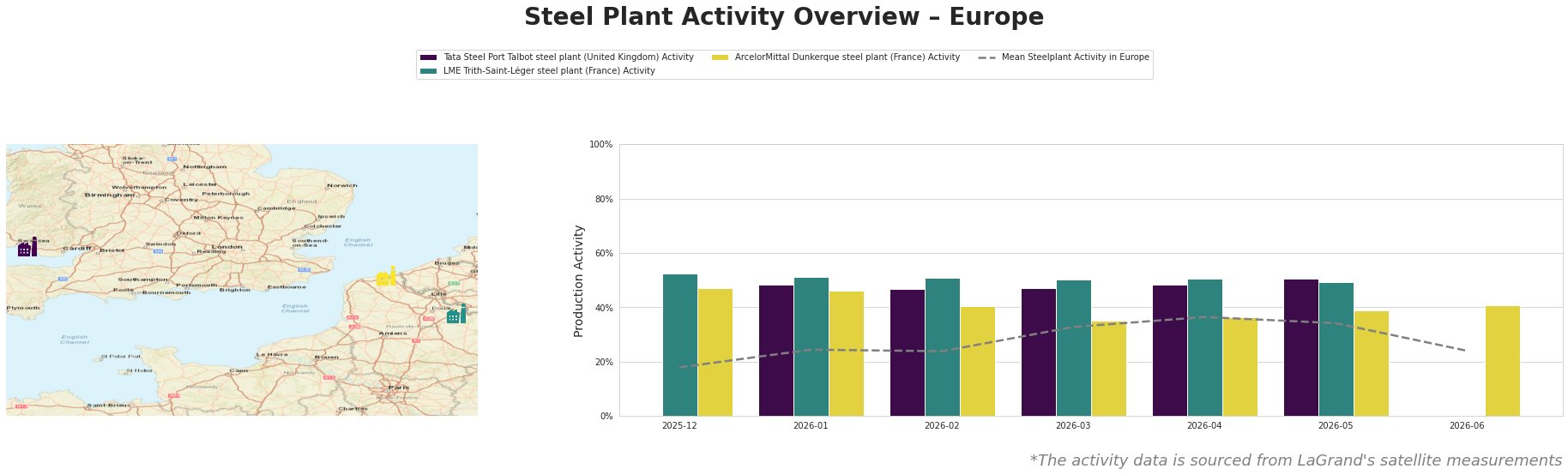
Tata Steel’s Port Talbot plant experienced a significant operational interruption, leading to a drop to zero activity for June, linked directly to the incidents reported in “A fire has brought Tata Steel’s hot rolling mill in the UK to a standstill“. Conversely, the LME Trith-Saint-Léger plant maintained a stable activity level of 53% in December and saw only minor fluctuations, while ArcelorMittal Dunkerque experienced declines reflecting wider market trends amid the sector’s uncertainty.
Tata Steel Port Talbot Steel Plant: This integrated plant (BOF) in Wales has a crude steel production capacity of 5,000 tonnes per day. Following the fire on June 3, reported by both “There was a fire on the processing line at the Tata Steel plant in Port Talbot” and “A fire has brought Tata Steel’s hot rolling mill in the UK to a standstill,” activity levels have dropped to zero for June, indicating severe production disruption. The incident uniquely coincides with the implementation of new UK safeguard measures that complicate supply dynamics further.
LME Trith-Saint-Léger Steel Plant: Operating an Electric Arc Furnace (EAF) with a capacity of 850 tonnes, this plant remained stable, with activity levels at 51% in both January and February. There’s no direct link to the Tata incident, suggesting its operations are insulated from the disruptions affecting major competitors.
ArcelorMittal Dunkerque Steel Plant: This integrated plant focuses on BOF technology and can produce up to 6,750 tonnes of crude steel. Its activity levels have remained consistently lower than competitors, with some slight recovery to 41% by June. However, the decline reflects broader market challenges rather than direct disruptions.
In summary, significant supply disruptions from Tata Steel’s Port Talbot plant could result in reduced availability of hot-rolled and galvanised steel products in the UK market, prompting steel buyers to consider diversifying their sourcing strategies. It is recommended that procurement teams closely monitor the developments and prepare for potential sourcing from LME Trith-Saint-Léger or explore long-term agreements with ArcelorMittal Dunkerque to mitigate risks associated with Tata’s recovery timeline.