


From the Field to the Dashboard – Built by Experts, for Experts.
Discover What's Really Happening in the Steel Industry
Use the AI-powered search engine to analyze production activity, market trends, and news faster than ever before.
Try the Free AI Search EngineEurope Steel Market Faces Downward Pressure Amid Weak Demand
The European steel market is currently experiencing significant challenges, primarily driven by weak demand and financial uncertainty. Recent reports, such as “In a weak market, the price range of Polish steel rebar is expanding; wire rod prices are stable“ and “Bulgarian rebar prices soften amid financial uncertainty, wire rod remains resilient,” provide insights into declining activity levels and shifting price structures across the region’s steel plants.
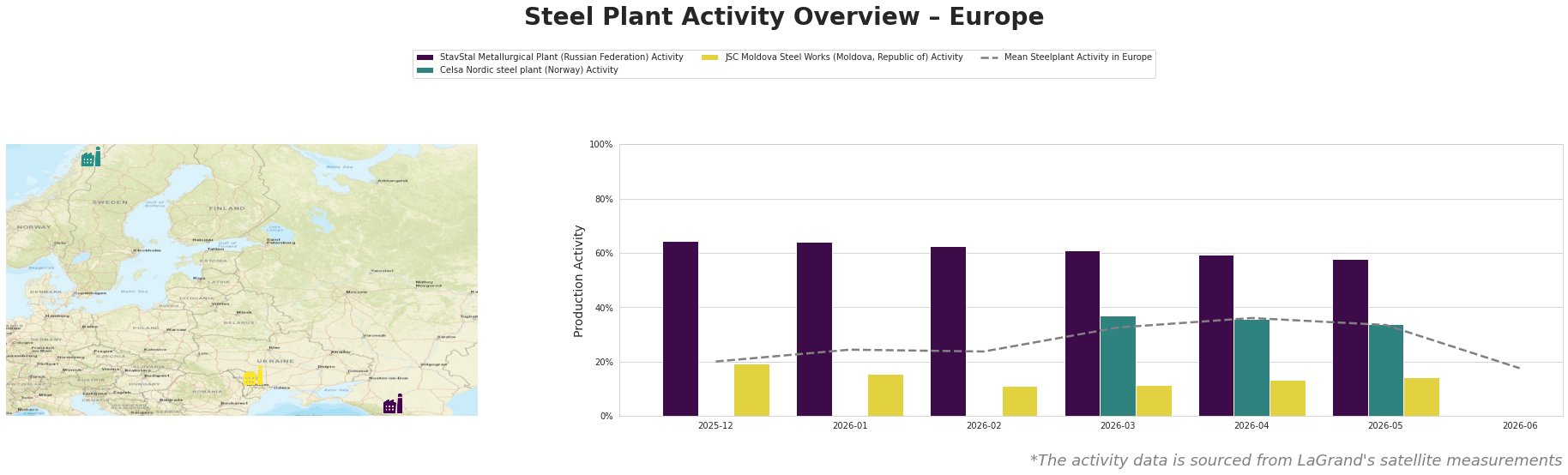
The overall mean activity across European plants indicates a notable decline from 36% in April to 18% in June, signaling decreasing operational levels. The StavStal Metallurgical Plant showed a steady decline from 65% in December to 58% by May, corroborating the weak rebar market sentiments echoed in the Polish report; however, no direct link with recent activities was identified.
At Celsa Nordic, the plant recorded activity levels fluctuating up to 37% in March but dropped to 34% in May, which aligns with the broader trends identified in the Bulgarian price fluctuations reported to be due to weaker domestic demand and uncertain financial conditions, as articulated in “Bulgarian rebar prices soften amid financial uncertainty, wire rod remains resilient.” In contrast, JSC Moldova Steel Works exhibited a drastic drop to 11% in February, suggesting substantial operational issues, although specific connections to market news remain vague.
Currently, procurement decisions should be driven by regional price adjustments and stock strategies. Buyers may consider limiting high-volume orders, focusing instead on immediate needs, as highlighted in the Bulgarian news, where cautious buying behavior prevails amidst rising stock levels. Additionally, with Bulgarian imports becoming increasingly competitive, there’s an opportunity for buyers to explore lower-priced options from Italy and Romania before they take further hits, as observed from the volatile activity rates across various plants. Overall, the market sentiment remains grim with potential supply disruptions anticipated, particularly from the underperforming Moldova facility, which could continue to strain inventory levels for EU buyers.