


From the Field to the Dashboard – Built by Experts, for Experts.
Discover What's Really Happening in the Steel Industry
Use the AI-powered search engine to analyze production activity, market trends, and news faster than ever before.
Try the Free AI Search EngineBrazil’s Steel Market: Activity Stabilizes Amid Export Surge and Import Declines
Brazil’s steel market outlook remains Neutral as recent dynamics reflect significant export increases and notable import declines, particularly for hot dipped galvanized (HDG) and rebar products. This is supported by articles such as Brazilian HDG exports surge 330 percent in April as imports fall 71 percent and In April Brazil rebar exports rise on stronger shipments to South America, while imports fell on no Egyptian supply. Such changes correlate with observed shifts in satellite activity data, highlighting critical impacts on supply patterns.
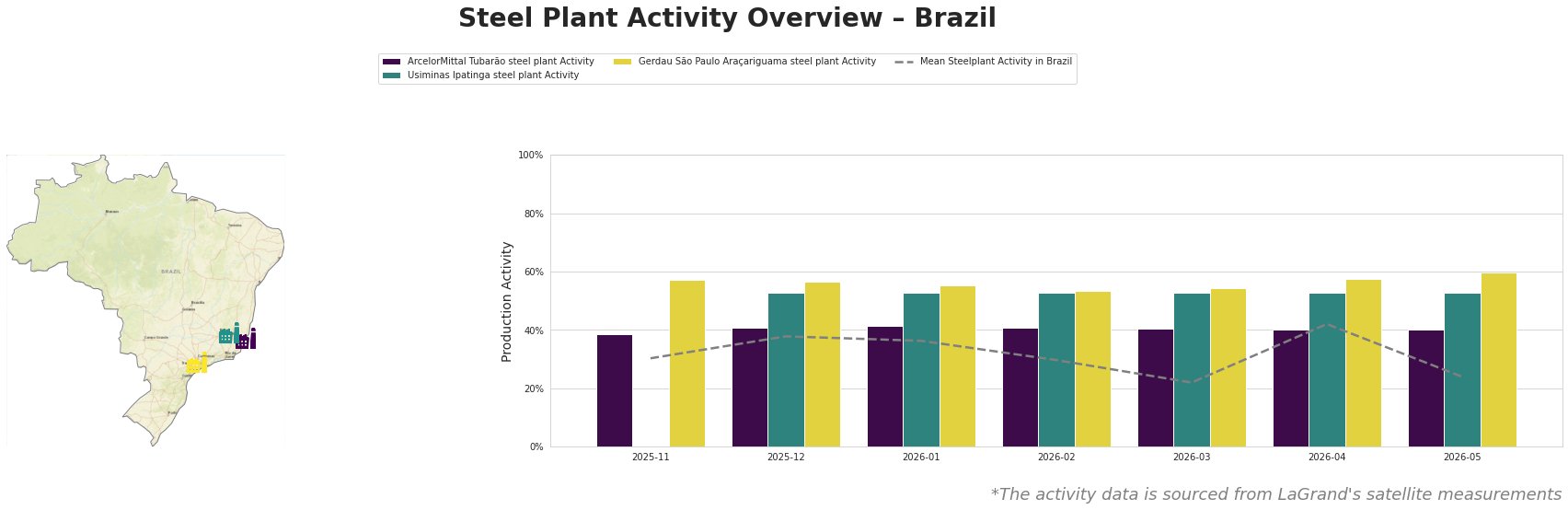
The ArcelorMittal Tubarão steel plant has shown fluctuations, with a peak of 41% activity in December 2025 followed by declines, stabilizing at 40% in April, indicating consistent production levels despite market shifts. The Usiminas Ipatinga facility maintained steady operations at 53%, exhibiting resilience despite significant market changes; however, no direct link was evident between this stability and recent export activities. Notably, Gerdau’s São Paulo Araçariguama plant saw an increase to 60% by the end of May, coinciding with Brazil’s rising rebar exports detailed in In April Brazil rebar exports rise on stronger shipments to South America.
Evaluating plant activities against export data reveals potential supply disruptions in the HDG and rebar segments, as imports plunged due to reduced Egyptian and Chinese supplies. Steel buyers should consider the rising export trends when planning procurement. Specifically, the significant export surge for HDG and rebar to South America signals an increased demand, suggesting a strategic shift toward localized sourcing could mitigate risks associated with fluctuating international supply lines.
In conclusion, steel buyers should focus on:
- Securing contracts with Gerdau and ArcelorMittal to capitalize on their strong production capacity and responsive supply chains as evidenced by their export activities.
- Monitoring changes in export demand, particularly for HDG and rebar, to preemptively adjust procurement strategies based on potential supply availability.
- Remaining vigilant about the impacts of international trade policies on imports, particularly in light of ongoing geopolitical tensions affecting supply from countries like Egypt and China.
By aligning sourcing strategies with these insights, procurement professionals can enhance their market positioning amid the evolving Brazilian steel industry landscape.