


From the Field to the Dashboard – Built by Experts, for Experts.
Discover What's Really Happening in the Steel Industry
Use the AI-powered search engine to analyze production activity, market trends, and news faster than ever before.
Try the Free AI Search EngineAsia’s Steel Market Sentiment Remains Neutral Amidst Tariff Threats and Fluctuating Plant Activity
Recent changes in the Asian steel market are influenced by external trade dynamics, particularly the potential repercussions of U.S.-EU tariff threats. The ongoing discussion surrounding tariffs on European automotive imports, notably detailed in “The US will impose 25% tariffs on cars if the EU does not approve the trade agreement“, has raised concerns about cross-continental trade relations affecting steel supply chains. Despite these tensions, satellite-observed activity data suggests that while some steel plants show resilience, overall activity has fluctuated, leading to a mixed market sentiment.
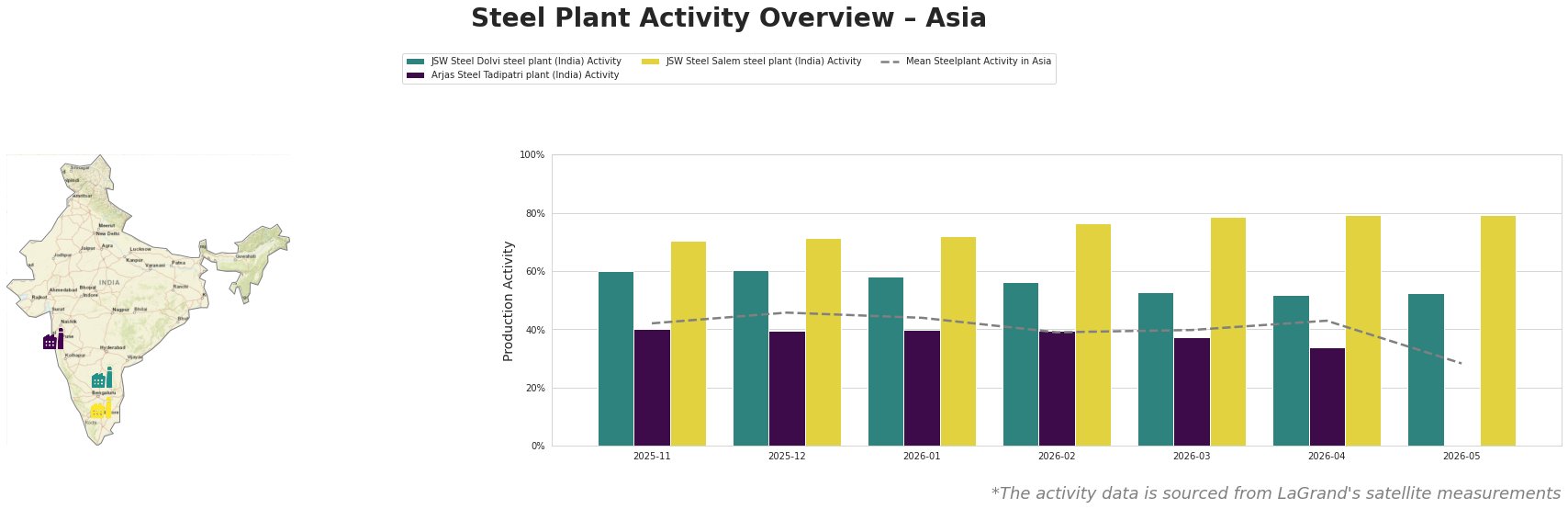
Notable activity trends reveal a decline in mean steel plant activity from 43.0% to 28.0% between April and May 2026, reflecting ongoing uncertainties in production amidst tariff threats. The JSW Steel Dolvi plant maintained stable activity around 52.0%, whereas JSW Steel Salem exhibited resilience with a firm activity level of 79.0%. In contrast, the Arjas Steel Tadipatri plant showed a significant drop to 34.0% in April, with no activity reported for May, highlighting vulnerabilities in the face of market pressures.
The JSW Steel Dolvi steel plant operates mainly as an integrated plant leveraging both blast furnace and DRI technologies, producing a range of finished and semi-finished steel products for multiple sectors, including automotive and construction. Its recent activity leveled at 52.0% from April to May reflects stability amidst the broader market decline; no clear link to external news has been established.
Arjas Steel Tadipatri plant, predominantly utilizing a blast furnace, reported a concerning dip in activity to 34.0%. This significant deviation could be related to broader trade tensions noted in the article “Trump threatens higher tariffs on European cars, trucks,” which imply implications for raw material costs and availability, although no direct correlation has been charted.
The JSW Steel Salem steel plant has shown remarkable resilience, maintaining activity at 79.0% through recent months. Its integrated operations leverage high-efficiency technologies but may still be exposed to market shifts influenced by external tariff developments.
The potential for supply disruptions linked to the U.S. tariffs reinforces the need for actionable procurement strategies. Steel buyers should consider diversifying their sourcing strategies, especially for products from the more adversely affected Arjas Steel Tadipatri plant, while taking advantage of the operational robustness seen at JSW Steel Dolvi and Salem plants.
Professional analysts should closely monitor the evolving U.S.-EU trade negotiations and the potential impacts on regional raw material costs and steel pricing, ensuring that procurement actions are timely and strategically aligned with observed market trends.