


From the Field to the Dashboard – Built by Experts, for Experts.
Discover What's Really Happening in the Steel Industry
Use the AI-powered search engine to analyze production activity, market trends, and news faster than ever before.
Try the Free AI Search EngineAsia Steel Market Outlook: Activity Holds Steady Amid Global Uncertainties
In Asia, the steel market sentiment remains Neutral, influenced by geopolitical tensions and fluctuating demand. The article “Assofermet Acciai: Italian steel market faces weak demand, geopolitical uncertainty” indicates a pullback in European steel demand, likely impacting supply chains throughout Asia. This sentiment is mirrored by recent activity trends, particularly in notable steel plants in the region.
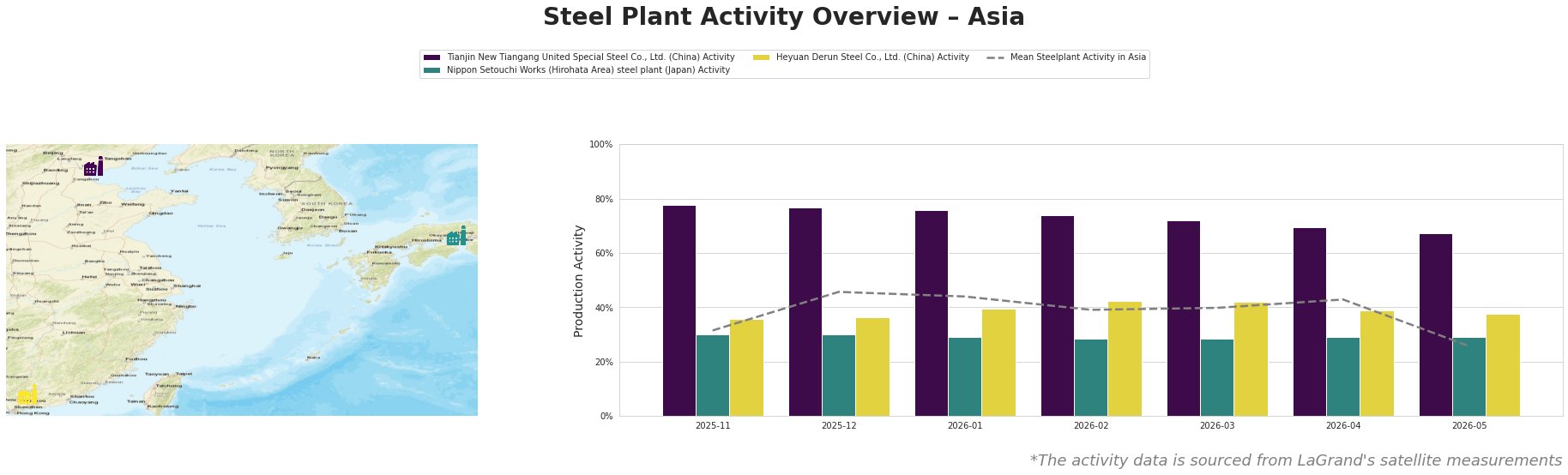
The Tianjin New Tiangang United Special Steel Co., Ltd. shows a notable decline in activity from 78% to 67%, indicating reduced capacity utilization reflective of weakening demand patterns noted in “Assofermet Acciai: Italian steel market faces weak demand, geopolitical uncertainty”. This downturn directly correlates to the broader concerns about demand in the carbon flat steel segment, as lower sales volumes prompt scaling back operations.
The Nippon Setouchi Works, operating predominantly at a consistent 29%, aligns with stable, albeit low, demand for finished products. However, this stability may be fragile given regional demand fluctuations and recent costs imposed by CBAM, referenced in several articles including “European heavy plate round-up: EU plate stable as CBAM costs suggest price floors”.
Activity at Heyuan Derun Steel Co., Ltd. also reflects cautious sentiment, with an observed drop from 42% to 38%. This movement suggests aligned pressures from both reduced local demand and potential disruptions in sourcing due to geopolitical uncertainties, echoing sentiments from the aforementioned articles.
Given these dynamics, steel buyers should consider diversifying sources to mitigate risks associated with localized production decreases, especially from sensitive regions like Tianjin and Guangdong where considerable reductions in activity are noted. Establishing contracts with alternate suppliers may provide an essential buffer against potential production disruptions highlighted in the Assofermet Acciai report, particularly as market conditions evolve and regulatory changes loom.
In conclusion, while activity levels remain moderate, the potential for supply chain disruptions is evident. Strategic procurement actions should be enacted to navigate the current phase of uncertainty, ensuring continued access to necessary steel inputs while leveraging existing market stability where possible.