


From the Field to the Dashboard – Built by Experts, for Experts.
Discover What's Really Happening in the Steel Industry
Use the AI-powered search engine to analyze production activity, market trends, and news faster than ever before.
Try the Free AI Search EngineItaly’s Steel Market Analysis: Stable Prices Amid Weak Demand and Production Cuts
Italian steel markets have been affected by ongoing weak demand and production adjustments, as highlighted in European long steel prices steady; mills curb output amid low buyer interest (2026-07-02). This has led to a notable drop in activity levels at several steel plants, confirming the challenging sentiment in the market.
Recent satellite observations reveal that Feralpi Siderurgica Lonato’s activity decreased from 36% in April to 29% in June, while Alfa Acciai Brescia remained more consistent with a slight dip from 45% to 44% during the same period. In contrast, Pittini Siderpotenza Potenza’s output showed resilience, remaining relatively stable, with a recorded activity of 72% in July. The swings in activity levels directly align with reported low buyer interest, signalling a cautious market and limited trades, as articulated in European longs market still weak, new EU CSQs discussed by market players (2026-07-04).
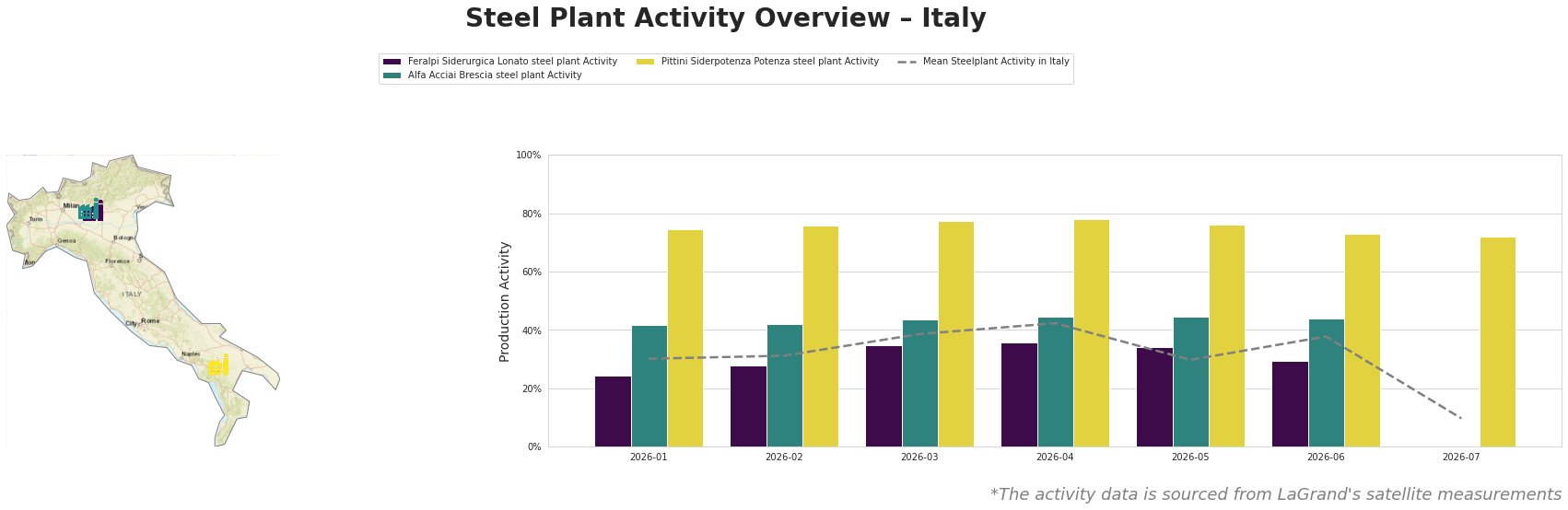
Feralpi Siderurgica Lonato, located in Brescia, primarily produces rebar through Electric Arc Furnaces (EAF) and has seen a 5% drop in activity over the last month. This decline can be correlated with the overall market sentiment and demand slowdown outlined in European long steel prices steady; mills curb output amid low buyer interest (2026-07-02).
In contrast, Alfa Acciai Brescia has maintained a relatively stable output despite market strains, holding steady at 44% in June. This resilience may be attributed to their operational efficiency and diversified product offerings, catering to existing demand albeit at lower volumes.
Pittini Siderpotenza Potenza has shown remarkable stability, with a July activity level of 72% despite market weaknesses. This can be seen as a response to the new EU quota regime, where significant firms anticipate tightening supply, urging producers to retain higher output levels to maintain market presence.
Potential supply disruptions are clearly indicated, particularly for rebar suppliers like Feralpi, which could struggle with consistent production due to fluctuating demand.
For steel procurement professionals, it is critical to closely monitor developments regarding new EU country-specific quotas to evaluate potential impacts on pricing and supply chains. Immediate actions include assessing supplier reliability, diversifying procurement strategies across vertically integrated players, and maintaining open channels for communication with key suppliers to navigate the uncertain landscape effectively post-summer.
By aligning procurement strategies with observed activity trends and nuanced market sentiment, buyers can enhance their operational resilience against ongoing market fluctuations.