


From the Field to the Dashboard – Built by Experts, for Experts.
Discover What's Really Happening in the Steel Industry
Use the AI-powered search engine to analyze production activity, market trends, and news faster than ever before.
Try the Free AI Search EngineNegative Steel Market Outlook in Asia: Key Trends and Implications for Buyers
Recent developments in the Asian steel market underscore a negative sentiment, characterized by notable activity reductions across key plants. The article “US merchant bar exports down 17.8 percent in April 2026 from March“ highlights a significant decline in US exports, which may suggest weakening global demand, negatively impacting Asian supply. Concurrently, our satellite data reveals diminishing activity levels at major steel plants, indicating tightening production capacity.
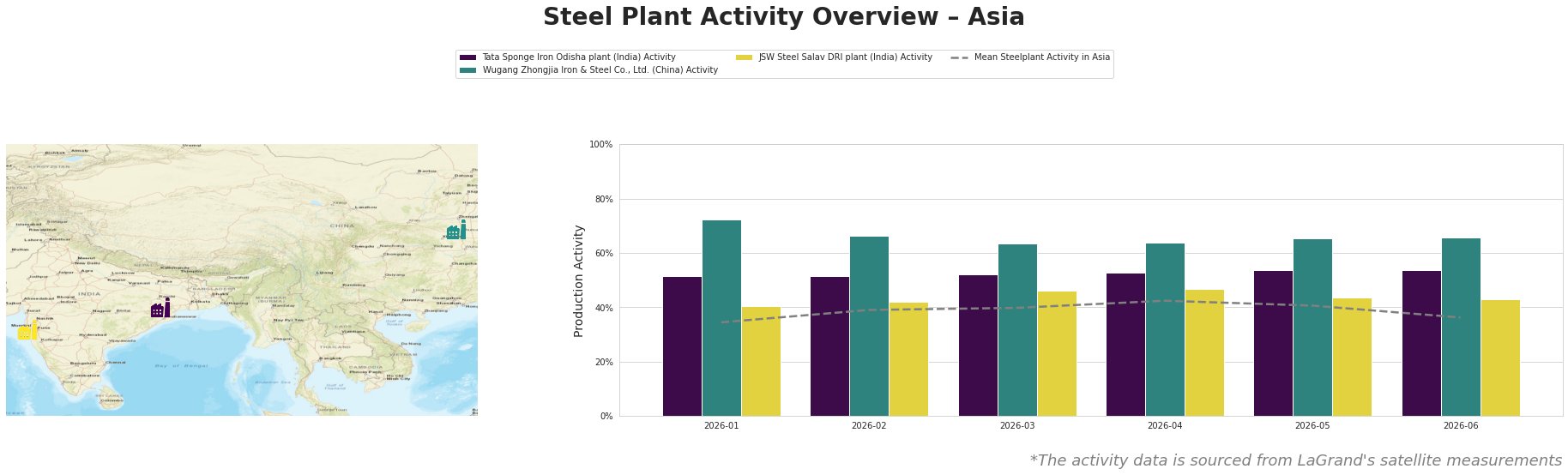
The Tata Sponge Iron Odisha plant, focusing on DRI production with a capacity of 400 units, maintained a relatively high activity rate, peaking at 54% in May. However, the subsequent decline to 54% by June signifies a troubling stability amidst an overall downward trend in the region, reflecting lower demand influenced by interruptions highlighted in “US merchant bar exports down 17.8 percent in April 2026 from March.”
In contrast, Wugang Zhongjia Iron & Steel Co., Ltd. has shown fluctuating activity levels, with a notable consistency around 66% in April and June. Its operations, however, may be at risk of facing demand-side pressures, influenced by the weaker U.S. export scenarios presented in the news articles but lacking direct correlation with specific plant performance data.
The JSW Steel Salav DRI plant, which similarly operates on a DRI basis, saw a gradual decrease in activity levels from 44% in May to 43% in June, suggesting a contraction in market demand, which echoes concerns from “India’s base oil imports fall in April on US-Iran war,” potentially affecting regional supply chains.
Given this data synthesis, steel buyers should prepare for potential supply disruptions, particularly in India and China, influenced by external demand pressures and geopolitical factors. We recommend closely monitoring activity trends in these key plants, especially given their proximity to fluctuating global trade dynamics. Additionally, engaging in proactive procurement strategies now may provide a buffer against forthcoming market shifts, as supply chain constraints and production adjustments become inevitable in light of the projected downturn.