


From the Field to the Dashboard – Built by Experts, for Experts.
Discover What's Really Happening in the Steel Industry
Use the AI-powered search engine to analyze production activity, market trends, and news faster than ever before.
Try the Free AI Search EngineSteel Market Surge in Asia: Insights from Activity Trends and Export Changes
In Asia, particularly China, a significant decline in stainless steel exports is impacting market dynamics. According to the article “China’s stainless steel exports down 30.84 percent in January-May 2026,” exports have decreased markedly, mirroring observed satellite data showing reduced activity levels at key steel plants in the region. Despite this downturn in exports, leading indicators from the raw materials sector show an increase in stainless steel scrap imports, which connects to rising production levels in certain facilities.
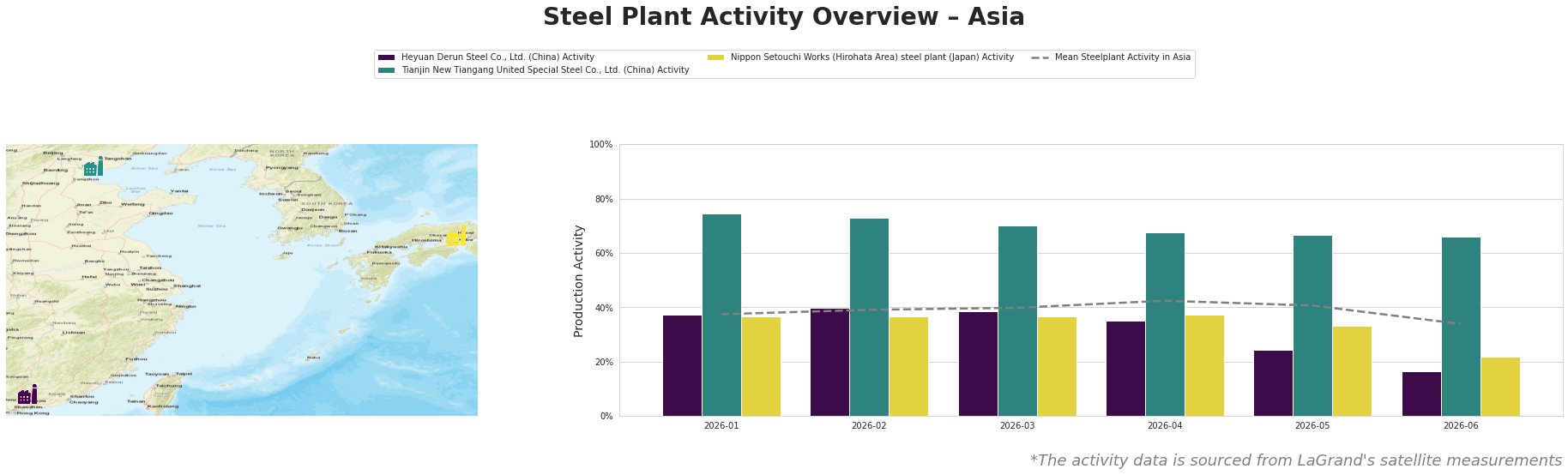
Heyuan Derun Steel Co., Ltd. in Guangdong has seen a sharp reduction in activity, from 37% in January to just 16% in June, marking a 57% decline. This drop could be linked to the decreased export figures mentioned in the article “China’s stainless steel exports fell by 30.8% y/y in January–May,” indicating that domestic production is struggling amidst lower international demand.
Conversely, activity at Tianjin New Tiangang showed more stability, fluctuating between 67% and 74% in the same period, revealing resilience in the face of export reductions. However, this plant’s capacity (4,500 mt of crude steel) suggests it might be better positioned to adapt to market fluctuations driven by domestic demand constraints.
The Nippon Setouchi Works in Japan maintains lower activity levels, showing a gentle decline to 22% as of June, comfortably aligned with stagnant international steel trade trends. The interconnected action of Chinese and Japanese plants reveals potential regional vulnerabilities amid falling steel export figures.
Given the recent declines, steel buyers should consider prioritizing procurement from stable producers like Tianjin New Tiangang, especially as they continue operating near full capacity despite supply disruptions highlighted by the “US reduced imports of rolled steel by 26.8% y/y in January–May,” which could open further opportunities for regional suppliers to fill the gap created by US market reductions.
In conclusion, while stainless steel exports have fallen significantly, production resilience in specific plants offers actionable procurement opportunities. Buyers should remain alert to developments in scrap metal imports and closely monitor the activity changes, focusing on sourcing from plants maintaining higher output levels.