


From the Field to the Dashboard – Built by Experts, for Experts.
Discover What's Really Happening in the Steel Industry
Use the AI-powered search engine to analyze production activity, market trends, and news faster than ever before.
Try the Free AI Search EngineEurope’s Steel Sector Thrives: Regulatory Shifts and Increased Activity Signals Booming Demand
In Europe, the steel market sentiment is currently very positive, bolstered by the announcement in The EU’s requirement regarding the smelting and casting of steel will come into force in October. As the new EU regulations take effect, observed satellite data indicates a notable increase in activity levels at key steel plants. Specifically, the data reflects an upward trend in utilization rates, partially influenced by the new regulatory environment surrounding imports and production practices.
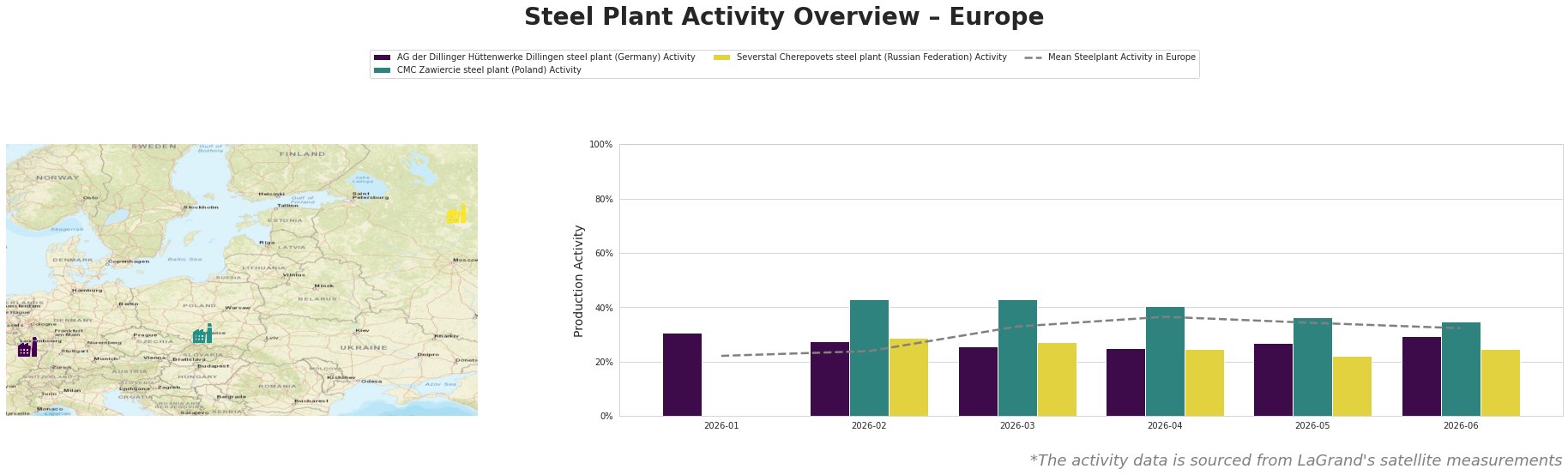
Starting January 2026, the AG der Dillinger Hüttenwerke Dillingen steel plant exhibited a stable performance, with activity peaking at 31% in January, declining slightly but remaining competitive. This plant’s stability could be linked to ongoing preparations for compliance with regulations like the “Melt and Pour” requirement, as indicated by The new EU steel production regulation, published in the official journal, includes a “Melt and Pour” requirement and a 50% tariff.
The CMC Zawiercie steel plant displayed the most significant activity fluctuations, peaking at 43% in February and sustaining around 40% in April, correlating with heightened demand for steel in sectors such as construction and automotive. This aligns with anticipated increases in consumption following regulatory adjustments, though no direct correlation with specific articles can be established.
Severstal Cherepovets showed consistent performance but with lower activity levels, not exceeding 29% at the end of June. This reflects challenges posed by broader geopolitical issues not explicitly addressed in the provided articles, limiting direct correlations.
Given the burgeoning demand in the European steel market coupled with impending regulatory measures, procurement professionals should prioritize sourcing from the CMC Zawiercie steel plant due to its higher operational responsiveness and recent activity spikes, particularly as regulations begin to structurally alter competition and availability.
Additionally, due to the elevated tariffs announced, steel procurement strategies must account for potential supply disruptions as costs are likely to increase. Consequently, it is prudent for buyers to lock in contracts ahead of the July 2026 regulation changes to mitigate future risk. The stability of the Dillinger steel plant, along with the proactive adaptations of Zawiercie, positions them favorably for contracts in the near term, facilitating a smoother procurement process amidst the evolving regulatory landscape.