


From the Field to the Dashboard – Built by Experts, for Experts.
Discover What's Really Happening in the Steel Industry
Use the AI-powered search engine to analyze production activity, market trends, and news faster than ever before.
Try the Free AI Search EngineSteel Market Outlook: Significant Declines in Asian Activity Amidst Rising Trade Tensions
Recent developments in Asia’s steel market reflect an overall negative sentiment as trade and regulatory pressures intensify. Notably, the article “Japan is imposing anti-dumping duties on imports of stainless steel from China and Taiwan“ highlights a shift in Japan’s trade strategy, imposing significant duties that may exacerbate current market challenges. Concurrently, India’s rising import scrutiny, as described in “India will monitor imports of Chinese steel before introducing new restrictions“, indicates a protective stance towards domestic producers amid increasing imports. However, direct correlations between these articles and specific plant activity levels remain unclear.
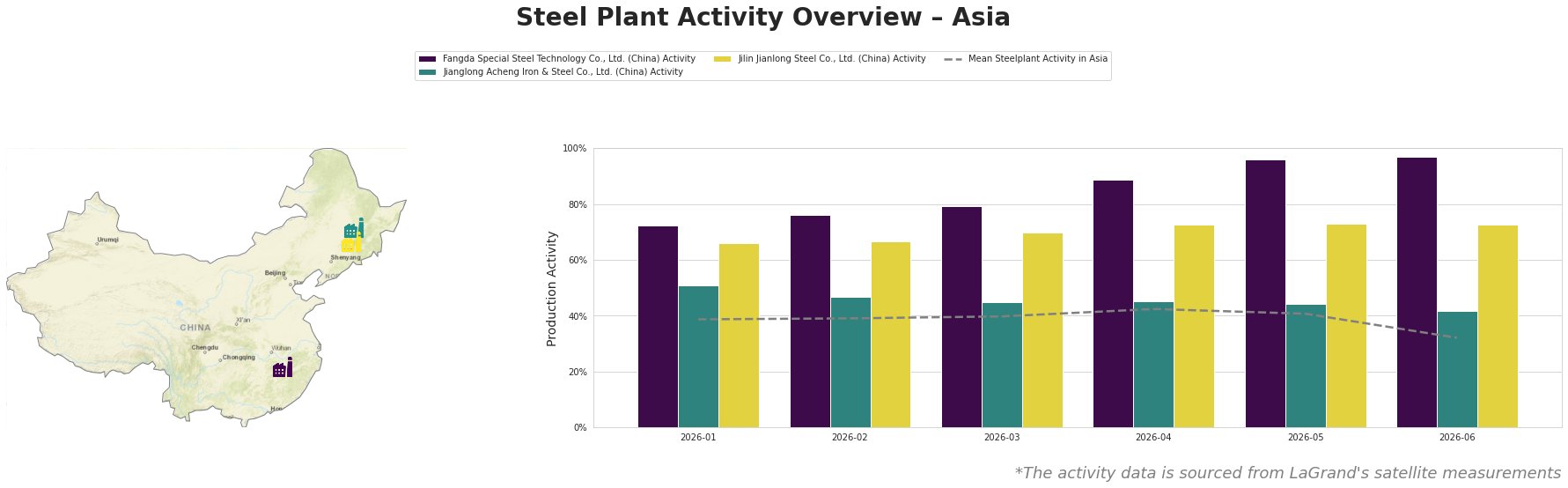
In early 2026, plant activity across the region saw fluctuations. Fangda Special Steel Technology Co., Ltd. observed a peak in activity at 97% in June, yet still aligns with the broader decline in market sentiment as it dropped significantly from 96% the previous month. Jilin Jianlong Steel Co., Ltd. demonstrated stable performance, maintaining a level of 73% despite emerging trade pressures. Conversely, Jianglong Acheng Iron & Steel Co., Ltd. faced a decrease to 42%, emphasizing vulnerability in the face of rising imports and fluctuating market demands, especially against the backdrop of India’s monitoring of imports as per the article “India starts AD probe into hot-rolled steel imports.”
Fangda Special Steel, with its capacity of 3,600 metric tons, primarily produces finished rolled products like spring flat steel, reflecting the impact of heightened duties. The peak activity in June, despite being high, indicates a potential over-reliance on specific markets and products which could be affected by Japan’s new tariff regime on stainless steel imports. Jianglong’s activity drop to 42% suggests a lack of competitive edge against dumped imports, further echoed in India’s protective trade measures, while Jilin’s stability provides a buffer against such pressures.
As a consequence of these dynamics, procurement professionals should consider:
-
Diversification of Supply Chains: With Japan’s new anti-dumping duties likely to lead to shifts in pricing and availability, buyers should actively seek alternative suppliers to mitigate risk.
-
Proactive Engagement with Local Producers: As India ramps up scrutiny on imports, there’s likely to be potential for renewed domestic supply chains. Buyers should engage with local producers for competitively priced steel options.
-
Monitoring Global Regulatory Changes: Continuous monitoring of trade policies will enable buyers to anticipate price fluctuations and supply chain disruptions.
In summary, the synergy between trade dynamics and observed activity data underscores the urgency for proactive buying strategies in the current uncertain market landscape.